Memorial Day

Hi, folks–

If you’re hanging out at home (maybe it got a little hot to do much on this Monday off), I recommend this book by Sebastian Junger:

War

source

The book accompanies a documentary called Restrepo, but if you’re not familiar with Junger’s writing, read this book. He is a master with phrasing, narrative, and sparse, gritty language that puts you right into the heart of whatever he’s describing. Here, Junger spent months shadowing an American infantry platoon in Afghanistan. Here’s a quote from a New York Times book review:

The best way to describe Junger’s book is to say what it is not. “War” does not attempt to explain the strategy behind the American war in Afghanistan, or the politics of Afghanistan, or even the people of the Korangal Valley. As the action unfolds, Junger makes no attempt to connect it to anything else happening inside the country.

Instead, he uses the platoon (the second of Battle Company, part of the 173rd Airborne Brigade) as a kind of laboratory to examine the human condition as it evolved under the extraordinary circumstances in which these soldiers fought and lived.
source, New York Times Review of Books, review by Dexter Filkins

Here’s a trailer from the documentary Restrepo, which won the 2010 Grand Jury Prize for documentaries at Sundance. My point? There is a reason we commemorate Memorial Day, regardless of your beliefs about war.

The language in this trailer is NSFW.


link
Zombie Apocalypse lore

Okay, so maybe it’s not quite “lore” in the classic sense of the word, but it IS a quirky tale of “life” during the ZA, as captured in haiku by someone who is turning into a zombie and then becomes a zombie.

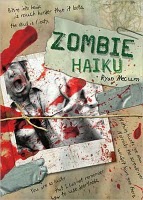
This clever documentation of the ZA is Zombie Haiku, by Ryan Mecum, published in 2008 by How Books.


source

Zombie Apocalypse via haiku. Who knew how much fun this could be? For those who don’t know what a haiku is, it’s a form of poetry that is three lines, each line with a designated number of syllables. In this case, 5-7-5. That is, 5 syllables in the first line, 7 in the second, and 5 in the third.

So a lovely zombie haiku from the cover of this book is:

Biting into heads
is much harder than it looks.
the skull is feisty.

source: cover of Zombie Haiku

The premise of this collection is clever, as well. It starts with a few lines of description of a survivor of the ZA. He originally started the poetry journal as a way to “capture the beauty of the world” through haiku. But then along comes the ZA and he writes hastily: “To whoever might find this, my name is Chris Lynch, and I’m pretty sure I’m dying. In face, if you are reading this, then I’m probably already dead. Not that anyone will be around to read this…from what I’ve seen, I’d guess this is the end of everything.” So as you start reading the haikus he’s written, it starts out all happy happy joy joy and then you notice he’s documenting the ZA, though he’s not aware that this is the case. He haikus about something in the news that says people are acting weird, but he turns if off. Then,

As I start my car,
my neighbor just keeps staring
and doesn’t wave back.

(p. 7)

He doesn’t realize, even with all the car wrecks and traffic and “drunk guy stumbling into traffic” what’s up. He gets to work, nobody’s there and one of his coworkers is “eating spaghetti in her car without utensils” and she smashes her head through the glass and tries to grab him, with glass sticking out of her neck. Anyway, our hero ends up not so lucky, and in the hands of a zombie mob. You see his metamorphosis through his clever haikus:

My skin is drying,
my veins are much ore pronounced
and I’m turning gray.

(p. 30)

one thing on my mind,
only one thing on my mind.
I’m going to eat you.

(p. 32)

Somehow, this zombie haikus being a zombie, and the illustrations and “dirt” and “blood smears” on the pages only add to the macabre, dark, hilarious fun in this book. The author’s handwriting morphs, too, and you end up seeing the world through the eyes of a zombie, whose haikus are short and sharp, like the staccato bursts of gunfire and the single-minded focus of an eating machine, which is what zombies are.

A seriously fun, clever, and wonderfully twisted book. See the ZA through a zombie’s eyes!

Happy reading, happy surviving!

Freaky Friday!

Hey, folks–

Before I get into this, head on over to Women and Words and discuss the Lambda winners. Congrats to all!

Okay.

So I’m doing a “staycation” for Memorial Day, and I thought I’d let those of you who are doing the same know that if you’ve got cable, the SyFy channel is running monster movies, most of which are so horrendously bad that you have to watch the heinosity unfold, like some kind of slow-motion train wreck. Must…look…away…but I can’t! How about this fabulous 2010 gem, MEGA PIRANHA!!!!

Giant mutant piranha eat their way from the Amazon toward Florida. OMG, is that Greg Brady? As the news guy? Holy crap. Anyway, here’s one of the more twistedly hilarious scenes from the movie, where our hero has to fend a bunch of these flying giant piranhas off:


link

And yesterday’s gem was the 2007 Ice Spiders, where mutant spiders invade the Colorado Rockies and end up hanging out on ski lifts jumping onto skiers. BIG spiders. Wild colors. Seriously. I am not making that up. And they make crazy noises, too, like chirps:


link

Anyway, Happy Memorial Day and while you’re having fun and hanging out with friends and relatives, maybe take some time to remember what the holiday is really about, and think about those who have died in service to the nation.

I still have an attention span–hey! A new iPad!

Caught this Publishers Weekly post thanks to fellow author Lori Lake, via Sisters in Crime. It’s a lament about our dwindling attention spans. Click here.

Bill Henderson, one of the co-authors of the book Book Love, which celebrates the printed book, notes that our techie-oriented society is literally changing the structure of our brains:

The e-experts said that in the future all information and literature would be available on the device of the moment (sure to be replaced by the device of the next moment). You may never have to leave the comfort of home or bed. The latest bestseller—indeed, millions of out-of-print books (you didn’t know you needed that many)—could be had at the click of a button. This was billed as an improvement.

Lots of people are making lots of money telling us this is for our own good. Tweeting away, we never stop to think. In fact, we may be losing the ability to think.

In The Shallows: What the Internet Is Doing to Our Brains (Norton, 2010), Nicholas Carr notes that after years of digital addiction, his friends can’t read in depth anymore. Their very brains are changing, physically. They are becoming “chronic scatterbrains… even a blog post of more than three or four paragraphs is too much to absorb… .Because our brains can no longer think beyond a tweet, we can’t write well. And we can’t read well either. The idea of reading—let alone writing—War and Peace, Bleak House, or Absalom, Absalom! is fading into an impossible dream.

source

He also notes that you’re probably not saving many trees with your ebook reader. Why not? Well, click the link and find out. It’s not saving resources. In fact, it’s adding lots of toxicity to the environment.

Just some food for thought.

Happy actual paper book reading!

Are you self-published? Want to be?

The blog Buzz, Balls, & Hype has been doing a series on self-publishing titled “Tough Love: Things No One is Brave Enough to Tell Self-Published Authors.”

Here’s Part 1
Part 2
Part 3

Quote, from Part 1:
Self or traditionally published, you need to produce the very best book that you can. That means being committed enough to rewrite your book three, four or twenty-five times. Even pros who have been at it for years and have dozens of books under their belts don’t have their first drafts published. So far it’s the same for self-published or traditionally published authors. But then the traditionally pubbed author turns his or her book over to professional editors.
If Lee Child, Sara Gruen, Laura Lippman and Jennifer Weiner all get edited, can self-published authors afford not to do the same thing?
Yes, an editor costs money. And yes, an editor might require you to do more rewrites. Yes, you might be tired of writing the book and not even want to work on it anymore.
But if your goal is to sell books, get readers, and build word of mouth – you absolutely need professional help.

source

There’s great advice and great nuts n’ bolts in this series. Check it out.

Happy writing, happy reading!

Something that doesn’t sit well with me

Hi, folks–

Took a little hiatus there. Hope everyone’s well. A writer colleague of mine sent me the link to this article, and it kind of irritated me. No, not the fact that my colleague sent me the article. THAT didn’t irritate me The topic of the article did.

It’s from The Telegraph in the UK and it’s titled “E-books drive older women to digital piracy.”

And I started gnashing my teeth before I even read it. Why? Because book and music piracy is totally not cool. It’s just not. It’s not only unethical, but it’s theft. Plain and simple. Here’s my take on it.

And here’s a quote from the article:

One in eight women over 35 who own such devices admit to having downloaded an unlicensed e-book.
That compares to just one in 20 women over 35 who admit to having engaged in digital music piracy.
News that a group formerly unwilling to infringe copyright are changing their behaviour as e-books take off will worry publishing executives, who fear they could suffer similar a similar fate to the record labels that have struggled to replace lost physical sales.
The picture across the entire e-reader and tablet markets is even more troubling for the publishing industry. Some 29 per cent of e-reader owners of both genders and all ages admit piracy. For tablets the figure rises to 36 per cent.

source

That’s pretty unsettling. And disappointing, especially if you’re a writer. As an individual, I choose not to rip people off, and I choose to pay artists and writers for the work they produce, as well as support the industries that publish them. Now, I also support libraries and ebook libraries. Here’s why. That’s a whole other issue. The point is, I’m bummed that technology has, in a weird way, created new pirates. Or perhaps that people have allowed themselves to be lured into it. I’m all for ebooks and ebook readers. But it does make me sad that people use the power of technology for not-so-nice things. Double-edged sword, technology.

Anyway, hope you’re getting through your post-Rapture depression. 8)

No Rapture, but how about a Zombie Apocalypse tip?

Hi, kids–

Well, I suspect you’re still here. News reports are saying NOTHING IS HAPPENING cataclysmically. No word, either, from the predictor of said Rapture, Mr. Harold Camping. Family Radio is playing nothing but devotional music and hymns, unrelated to the Rapture.

This is why stuff like this makes me think of cults. Seriously? A guy in New York blew $140,000 of his personal savings to put up ads and billboards and posters. [shaking head]

Anyway, this is just a funsies post about the ZA (which of course is WAY MORE REAL than the Rapture [I’m laughing]), but there are also good tips for basic disaster preparedness.

The CDC got into the “preparing for a zombie apocalypse” thing with this post, because they realized that whenever somebody mentioned Zombies in a Twitter feed or Facebook or something comparable, traffic went up. Zombies are popular, so the CDC used ’em to get us thinking about disaster preparedness.

Here are some tips from the CDC release, FYI:
Water (1 gallon per person per day)
Food (stock up on non-perishable items that you eat regularly)
Medications (this includes prescription and non-prescription meds)
Tools and Supplies (utility knife, duct tape, battery powered radio, etc.)
Sanitation and Hygiene (household bleach, soap, towels, etc.)
Clothing and Bedding (a change of clothes for each family member and blankets)
Important documents (copies of your driver’s license, passport, and birth certificate to name a few)
First Aid supplies (although you’re a goner if a zombie bites you, you can use these supplies to treat basic cuts and lacerations that you might get during a tornado or hurricane)

So, no Rapture, but it was cool that the CDC got into the zombie fun.

Happy Rapture Day!

This ain’t Blondie’s Rapture (sadly)

Hey, all–

So, presumably, at least half of you have heard that the Rapture is this Saturday. For those who are not up on Christian eschatology, that’s the day when the chosen ones are called on up to heaven and all the unbelievers and unsaved are left to rot here on the planet as it basically self-destructs. Pleasant for those of us “left behind,” if you will. [snark]

And yes, I am not among the chosen. Not that I ever pretended to be or wanted to be. I don’t believe that religion makes you more moral than others, or that it makes you special or superior to others. Nor do I believe that one religion is better than another, or that there’s a hierarchy of people that God, however you perceive him or her, designates.

At any rate, I like a good apocalypse, but stuff like this — with people proclaiming specific dates and thus usurping what’s supposed to be a power reserved for deities — makes me nervous, because a lot of people buy into it, and that’s just walking the cult line.


source

All that said, Harold Camping of Family Radio has been perusing his King James bible for decades, and he’s been looking for secret codes and numbers that would tell him exactly when the Rapture happens, and after manipulating those codes and numbers (using his own numerology), he came up with May 21, 2011 as the date. And because Camping’s been around since the 1950s, Family Radio has had lots of time to build up an audience. Which it has. It’s translated into 61 different languages and there are Rapture billboards all over the world.

More? Click on.

Continue reading

Cool blog alert

Hey, kids–

This is a site I use when I’m doing research or just feeling the need to check out criminalistics and forensic methodology. As some of you may or may not know, every other book (even-numbered) in my New Mexico series stars Chris Gutierrez, a detective in Albuquerque who works a lot of homicides. Now, I do have somewhat of a background in criminalistics and forensic anthropology through my graduate work and outside interest — I’ve taken courses outside my fields and workshops, as well and done a community police program — but when I need some help with research, I can go to this blog and probably find the answers I’m looking for or a way to get that answer. That is, if I can’t find any of my friends in the field to help me out in a pinch.

The Graveyard Shift

That’s veteran police investigator Lee Lofland’s blog. Here you’ll find tips on proper police procedure, crime scene investigation, proper technique and gear that law enforcement and emergency responders use. For example, the current entry is a guest blog by firefighter Joe Collins, who gives you a breakdown of new bunker gear (comparing it to older gear).

Here’s a taste of that, from Mr. Collins, a 12-year veteran firefighter/paramedic:

Modern bunker gear is constructed of space age materials—some of the same used in space suits. It must meet the requirement of not melting, igniting, dripping or separating when exposed to a heat of 500°F for five-minutes. Considering that in structure fires ceiling temperatures as much as 1000 F have been recorded, it doesn’t provide as much protection as you would think. Those temperatures are also why we do most of our work crawling along the floor.

source

There are photos, too.

So if you’re a writer of police procedural fiction, or just interested in how this stuff works, check out Lofland’s blog.

Happy reading, happy writing!