I’m thinking a bit about reviews. I know a lot of authors think about reviews. Sometimes incessantly. And yes, reviews can be helpful in terms of sales, both long-term and short-term. They can also be really harmful, but if you engage in this writing pursuit, guess what? That’s part of the territory.
In the world of books, reviews have a long and tortured history, as this 2012 Atlantic Monthly piece points out. Yes, friends, no matter the era, there are invariably complaints about reviews, reviewers, and what they ultimately accomplish. There are also always complaints about whether someone has the expertise in a particular genre or subject to do a review, and whether someone has a background in writing.
None of this is really new, friends. Certainly technology gives us the ability to post things quickly and create “buzz” (whether negative or positive). It also allows people to mask their identities and post whatever they want about a writer’s work. Which, again, isn’t necessarily new. It’s just a lot easier now than it was a couple decades ago to do it. The Interwebz have created an arena in which anyone can voice an opinion about a book (or any other product) and even develop reputations for reviews, and become kind of a reliable source for others about particular genres. You might, for example, find that you seem to like the same types of genres that, say, “pinklady998” likes, and you start following that user and find that you trust her/his reviews about certain things, which might in turn guide some of your own purchasing habits.
So reviews can also be tools. They’re a “word-of-mouth” kind of thing, in this crazy Internet age. So rather than hanging out with your friends on Friday night talking about the latest reads you got at the library (or at the bookstore), you post a review of a book online and that then becomes part of a larger conversation about the book/story that anyone else can engage in. Which is kind of neat, actually, that you can engage with other people from all over the world about a particular work.
As an author, though, you might consider the following guidelines regarding reviews. And I’ve said some of this elsewhere, but I’ll reiterate it here:
Acclaimed author Nancy Garden died yesterday at the age of 76. She was the author of Annie on My Mind, the 1982 novel in which a high school senior from an upscale neighborhood falls in love with another girl from a poorer neighborhood and from a very different family background. The two hit it off, but they have to contend with a few obstacles.
Many of you have no doubt read this now-classic young adult lesbian novel. If you read it when you were a teenager, no doubt it made you feel somehow better about being different. If you read it as an adult, it probably took you back to your teen years, when you were trying to figure out your feelings and who you might be. And might just have made you feel better about who you became.
Victoria Brownworth wrote this remembrance of Garden over at Lambda Literary. I don’t have the words in this instance, but fortunately, Victoria does:
Garden’s books were published by many of the top publishers — Knopf, Houghton-Mifflin, Holt, Harcourt, Lippincott, Scholastic, HarperCollins, Putnam, Random House, Dell, Farrar, Straus, Giroux and Bantam. But she was also published by smaller independent publishers including Bella Books.
She won dozens of awards, major and minor, and if the American Library Association (ALA), the New York Public Library and the Children’s Book Council each had a “watch for the latest from this children’s author” list, Garden would have been at the top–nearly all her books received awards and/or listing from all of them. Over a ten year span, Garden was nominated for a Lambda Literary Award every year.
Look again at that list of publishers and awards and remember that Garden was an out lesbian writing solely for the children’s market (her one adult romance novel was published by Bella in 2002). That made her an extraordinary, one-of-a-kind trailblazer for LGBT writing. From the time she published her first book in 1971 when she was 43, she wrote at least a book a year, but usually several. Her most recent book was published in 2012.
As Brownworth says, Nancy Garden was a rarity. “The consummate children’s book author.” She wrote dozens of books, Brownworth notes, “some gay-themed, some not, but it was this book, Annie on My Mind, which was a first of its kind, before Y/A was even a sub-genre within the catch-all children’s books genre, that was Garden’s best-known work. Farrar Straus Giroux had taken a chance on the novel and it paid off–the book has remained in print throughout the past three decades.”
But she wasn’t just an author. Garden was an avid though kind and respectful opponent of censorship (she ended up on banned books lists and her work was actually burned) who received the Robert B. Downs Intellectual Freedom Award in 2000 in recognition of her work defending intellectual freedom for young readers. In an interview with Cynthia Leitich Smith that Garden did in 2001, Garden stated,
Nothing is served, I think, by demeaning those who truly believe that books should be banned, or by arguing against them in a hotheaded way.
Conversely, everything is served by reasonable dialogue when that’s possible, and by making the point that although parents have every right to control what their own children read, they have no right to control what other people’s children read.
Everything is also served, I think, by pointing out the importance of the First Amendment and the danger of eroding it. In a society without the protection the First Amendment gives us, sure, you’d be able to ban books that I like but you don’t — but there’d be nothing to stop me from turning around and banning the ones you like. It’s important to remember that, and also that one of the first steps toward Nazi control of Germany was book burning.
She told Leitich Smith that she wanted to write for LGBT youth because “When I was growing up as a young lesbian in the 50s, I looked in vain for books about my people. There were none for kids, and the few I knew about for adults were always out of the library, which I later realized was probably a subtle (maybe backhanded would be a better word!) form of censorship.”
I did not have the good fortune to meet Ms. Garden, though I might have had the chance. She was the recipient of the Lee Lynch Classic Book Award for Annie on My Mind through the Golden Crown Literary Society and as GCLS associate executive director Liz Gibson told Victoria Brownworth in a statement, Nancy hadn’t yet written her acceptance speech, but no doubt she would have been prepared by July 9th, which is when the GCLS conference is scheduled to kick off this year in Portland. The GCLS echoed the sentiments of so many upon news of Garden’s death: devastated. “The lesbian community,” the GCLS statement to Brownworth read, “has lost a valuable treasure, and our hearts and prayers go out to Nancy’s partner, Sandy.”
Yes, we have indeed lost a treasure. An indomitable spirit whose tireless advocacy in different quarters provided hope and guidance to so, so many. Small comfort in the midst of such a loss, but we can also take comfort in the legacy she left. Let us not forget, and let us honor her work and spirit by continuing to advocate for voices that lack a platform.
I’ve been running around trying to get a print version of From the Hat Down up and operational.
It’s not working. It’s making me frustrated. REALLY frustrated.
The main issue is that the print people claim that the file I and my typesetter supplied is causing the print to be too light. You see, I ordered an ol’ skool paper proof, which means I ordered a preliminary version of the book, bound with the cover so I could see how it looks. The exterior looks fine. But the interior typeface is just too light. So I brought it up with the printer people who allegedly did some “tracking” to determine what the cause may be. Meanwhile, my typesetter checked, too. The settings in my typesetter’s file are fine. They’re where they need to be. The printer people insist they’re not (bless their hearts).
In the meantime, the book doesn’t get printed because I refuse to release a book whose type looks like it’s the 20th Xeroxed copy off another Xeroxed copy.
I spent around 15 years in publishing. My typesetter spent about 20. And my designer is still working in publishing. I met her 20 years ago at the press where we worked and at that point, she had a good 10-15 years of design experience under her belt. Ergo, we kind of know what we’re doing.
But the printer people are just not on the boat with us.
And this makes me Writer McCrankypants.
So, dear readers, at some point, I will have a print version available. For reals. But I want to make sure it’s a quality product that you will be able to read without thinking: “Damn. This typeface is so light.” Because that will make you Reader McCrankypants, and that is so totally not cool.
And yes, at some point, I will have some other e-formats available. Those issues are also contributing to my McCrankypants self. Send me some good ju-ju. Maybe the printer needs a ju-ju infusion, too. And all the e-platforms. Just massive good ju-ju everywhere. I think that will decidedly help. In the meantime, howsabout we listen to the playlist to From the Hat Down to make us feel better? Music always makes me feel a bit better.
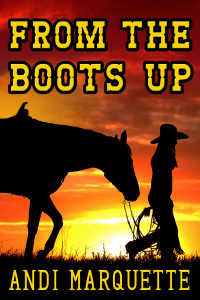
This is the follow-up to my Rainbow Award runner-up, the novella From the Boots Up. So you’ll see it posted in a variety of places — thanks, peeps! MUCH appreciated! Anyway, here’s more info plus some goodies to check out:
Synopsis
Meg Tallmadge is a veterinarian at a clinic in Laramie, Wyoming. She’s got a great job, great friends, deep ties to the family ranch, and big plans for her vet future. Sure, there are bumps in the road, like her mom’s continued denial about who Meg is and her painful and infuriating attempts to make Meg a “proper” woman. Then there’s Meg’s recent breakup with a girlfriend, which has her wondering why she can’t seem to open up to relationships. But Meg knows that life is messy, and sometimes all you can do is get through and shake it off. What she can’t seem to shake off, however, is her past.
It’s been almost ten years to the day since she met the love of her life, and about eight since she let her go. Meg has a hard time admitting that maybe she didn’t really let go, and that maybe some things you never really get over, no matter how hard you try. But her past is half a world away, caught up in her own life, relationship, and journalism career, and Meg isn’t one to chase the ghosts of past relationships. Even if they send you a birthday card and nudge what you thought were the closed-off parts of your heart. After all, second chances are the stuff of fantasies and movies where the good guy always gets a happy ending. You can’t count on something like that.
Hi, all! I was tagged by writers Sky Croft and Carol Wolf to participate in this here blog hop thingie in which writers answer four questions about their writing and work.



 Andi Marquette
