PR advice: don’t be a douchecanoe

Hiya, peeps!

I see there is a scary POLAR VORTEX that has descended upon parts of the country. This sounds like some sort of freaky space/time conundrum that involves cold. Regardless, it’s butt-ass cold out there for a lot of you, so take precautionary measures.

I will now provide authors with some hot air advice to warm you up regarding marketing and promo. This list is by no means exhaustive (nor is it meant to be), and I’ve mentioned a few of these points at varying times on my varied blogs. Just a few quickie tips that hopefully will keep you from being branded Sir Royal Asswipe of the Douchecanoe in readers’ and writers’ circles.

source

Continue onward for tips to ward off douchecanoeing.

Continue reading

A dog’s life

Hi, all.

Today is the two-year anniversary of the death of my best canine buddy, Taylor.

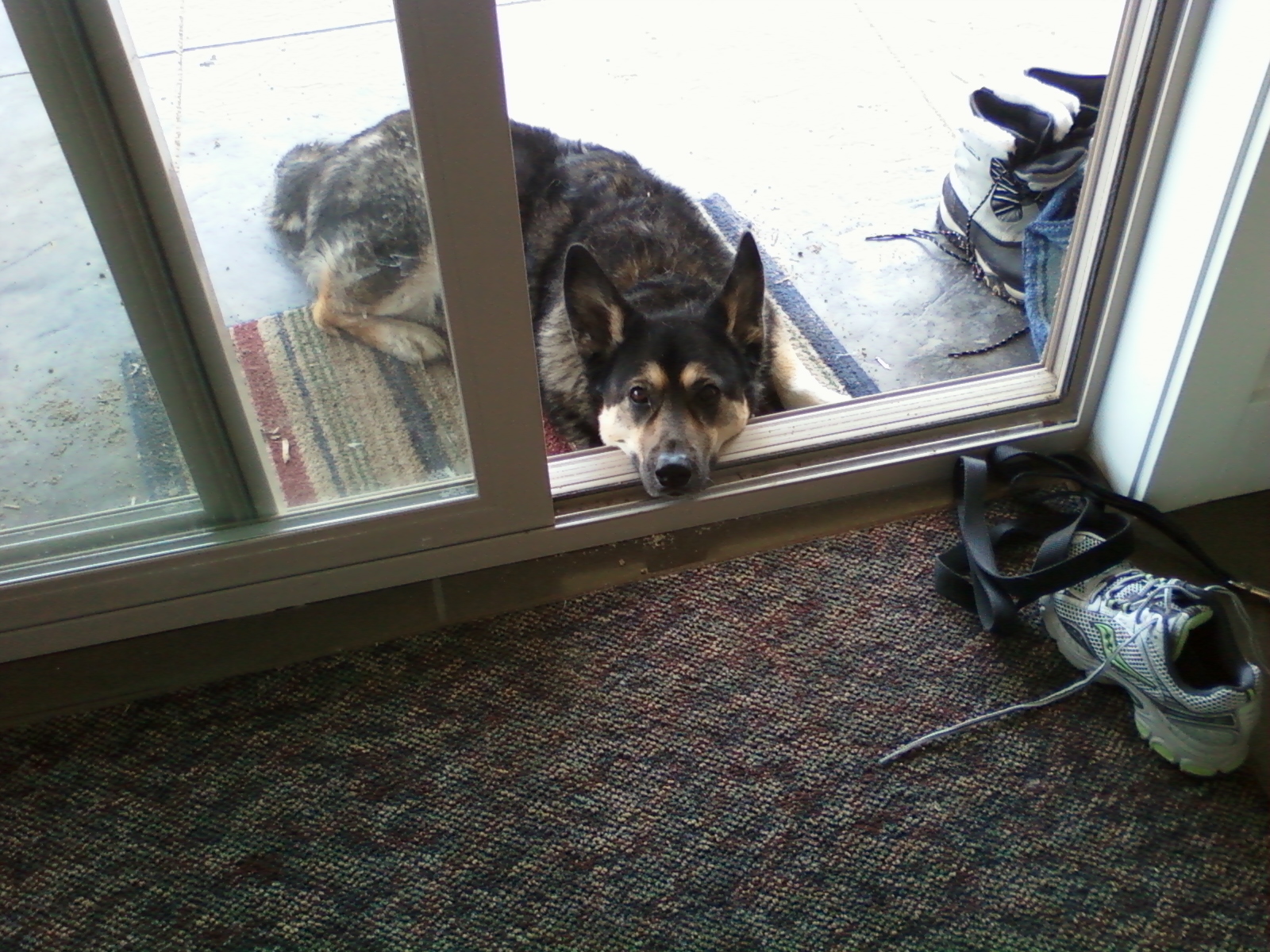
taylor in the doorway

I grew up in a household where there were always dogs, and those dogs were always part of the family. They lived primarily indoors with us. I know there are people out there who just don’t “get” the animals in the house thing for whatever reasons. That’s fine. But I’m not one of those people. Taylor was my constant companion for over 14 years, and my guru in many ways. She was a rescue dog, but not from a shelter. I found her sitting on the side of a New Mexico highway one July day after I’d been camping at Mt. Taylor (hence her name).

source

I pulled over because most dogs out there — Rez dogs — tend to look like they know where they’re going and what they’re doing. And they’re certainly not sitting on the side of the road. I got out of my car and she watched me, but she didn’t bolt. I got within about twenty feet of her and I crouched down and said: “C’mere. Come on.” And I beckoned at myself with my hand. She got up and very slowly came toward me, kind of slinking, ears back (she had HUGE ears — they earned her the nickname “Batdog”) and tail between her legs. I held my hand out so she could sniff my fingers and she did. She sniffed for a few seconds and then decided I must’ve been okay, because she got closer and literally climbed up into my lap and licked my face.

I took her to the vet the next day for vaccinations. She was in bad shape. Twenty pounds underweight, tapeworm, and dull, icky fur. I told the vet I was hoping to find a home for her because I didn’t have a place where I could keep her. I was living in a second-floor apartment in a historic building in Albuquerque at the time. The vet looked at me and smiled. “She already found a home.” She told me that when Taylor had put on some weight, in a few weeks, to bring her back for checking. Damn that vet. She could tell that Taylor was already settling in.
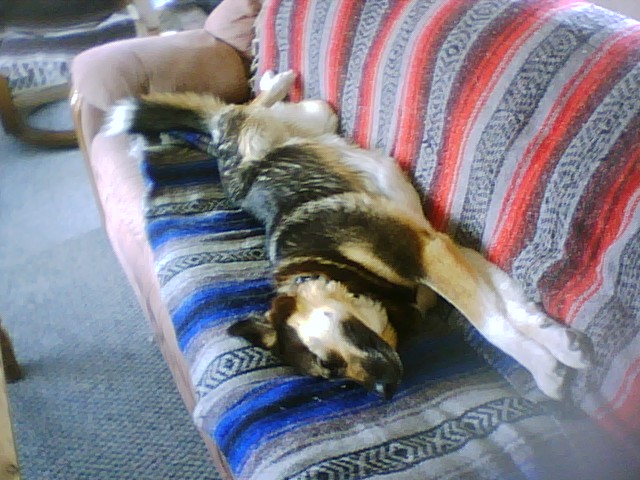
T sleeping

And sure enough, at the end of the summer, I’d moved to a place where I could have Taylor. She’d put on weight (she was 55-60 pounds most of her life), we’d gotten rid of the tapeworm, and she was starting to be okay around me and other people. She and I spent most of the summer at a friend’s house, where there was a fenced yard, until I found another place. And that fall, we went to doggie training school. I worked with her every day on the things we learned in class. Taylor was part shepherd, and shepherds are working dogs. So she liked having tasks and things to do. After graduation (Taylor was summa cum laude), we spent another few weeks on “distraction training,” which involved large groups of people and dogs and putting your dog through his or her paces. The object was to get the dog used to being around groups like that and focused on you and you only.
t in the snow

I continued distraction training for weeks afterward. I’d take her to Albuquerque’s Old Town and put her through her paces amidst tourists. She went to work with me on campus several times, and would sprawl out and snooze under my desk. She’d also go with me late nights to the public radio station where I volunteered and hang out with me while I did a world music show. She went to the airport (this was before 9/11) to get used to escalators and a whole other slew of people. I traveled with her all the time in the car, and she was very good at that, too.

t on porch
And slowly, Taylor blossomed into her funny, wise, diva self. She was a joy to have around, and we got to know each other so well that all I had to do was look at her and raise an eyebrow and she knew it was time to go for a walk and she’d jump up and go to the door and wait. As she aged, she became more talkative (I think she had some husky in her) and would yowl and carry on to let me know when she was excited or pissed about something.

Other times if she was pissed at me, she’d give me doggie “stink eye” until I was appropriately contrite. Or, if she was REALLY pissed, she’d do what I call “stink back.” She would sit and make sure I was looking at her and then she would deliberately turn her back to me and ignore me for a few seconds. Then she’d look back over her shoulder to see if she had my attention. If I hadn’t asked for her forgiveness, she’d do more stink back. So I’d have to say, “Oh, T! I’m sorry!” And then she’d relent.

And she loved it when I noodled on my harmonica. When I got it out, she’d get excited and she’d sit up and stare and start “warming up.” Kind of a “rowr rowr rowr” thing. I’d play a few notes and she’d do some more “rowr rowr rowr” and then I’d start just playing whatever and she would burst into howls interspersed with “rowr rowr rowr.” It was hilarious.

She used her paws for attention, too. She’d come up and put her paw on your foot or, if you were sitting, your thigh, and she’d pull at you to pet her. She’d also put her paw right across a newspaper or magazine if you were sitting reading it. And she’d do a “Bambi eyes” expression so you couldn’t be mad at her. She was also a practical joker. Once, when we were hanging out with someone who had a shih tzu, Taylor figured out which toy was the other dog’s fave. It was this fuzzy squeaky toy that the dog carried everywhere. So Taylor waited until the dog went into the kitchen with the squeaky toy. Taylor followed. The other dog had put the toy down and was trying to convince its owner to give it a treat. The dog was not paying attention to the toy, and like a freaking fox pouncing on prey, Taylor jumped on the toy and raced out of the kitchen. The other dog just stared after her, stunned. I followed Taylor into the living room, and Taylor had hidden the toy behind a pillow on the couch. She looked at me and I kid you not, she SMILED. I laughed so hard my stomach hurt. Eventually, I gave the toy back to the other dog, when Taylor wasn’t looking.

I’ve been thinking about all of those things today. I still really miss her and no, another dog has not entered my life. I did become a regular donor to another no-kill animal shelter, and at a recent event in New Mexico, I donated all proceeds from sales of my books to a local no-kill shelter. I’m a believer in rescue animals, and in rescuing animals. So yeah, I’m a softie. But Taylor changed my life for the better, and I try to help other animals when and where I can. I don’t have any interest in bringing another dog into my life at the moment, but I suspect that eventually, Taylor will send a dog because I still have things to learn.

So to all of you who knew Taylor, I’m glad you got to meet her. For those who didn’t, I hope sharing these tidbits about a remarkable dog who gave me more than I ever thought possible lets you see a bit about who she was and why I miss her so much.
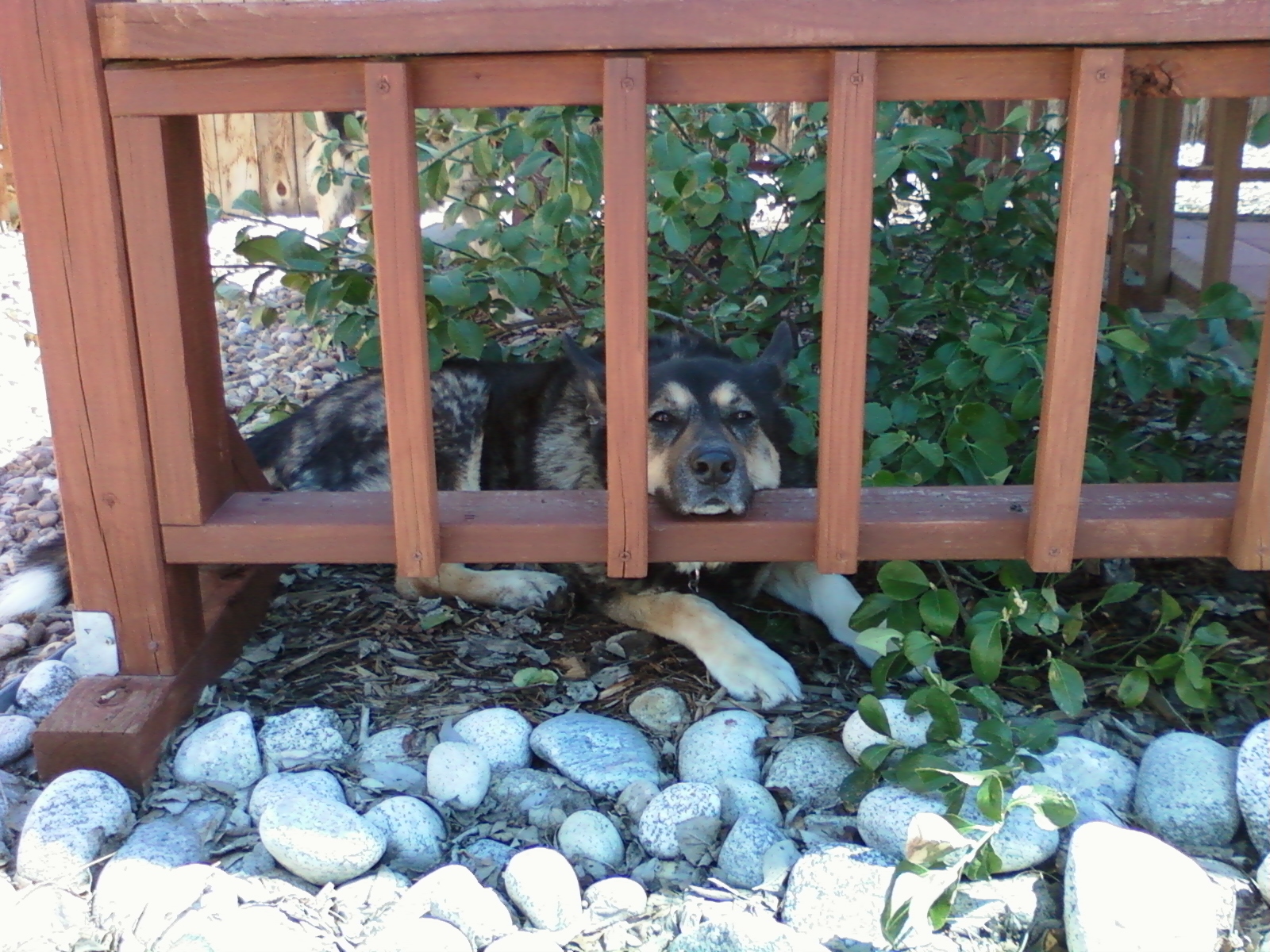
T in jail

Thanks for hanging out with me a bit today. Happy Saturday.

People and places

Hi, all —

I’ve been thinking more about characters, and how to inject authentic regionalisms into yours. That is, how to make a character sound and act like he or she is a product of a specific place and culture.

To that end, I read journalist/writer/speaker/all around awesome woman Caitlin Kelly’s blog today, and it seemed to resonate with what I’ve been mulling. Her latest blog is about defining “New York-ism.” That is, what defines someone as a New Yorker? And then she lists several things that New Yorkers might say and do, and the reasons behind them. Go have a look. See what you think.

And keep reading, if you want to see where the hell I’m going with this. 😀

Continue reading

Writing builds character.

Hi, peeps!

If you’re headed to the Left Coast Lesfic Conference, I’ll see you there!

I’m slated to do a workshop on character. That is, developing them. Making them groovy for sexy-time reading. Making readers WANT to follow your characters and find out where they go, whether they grow, or even if they fall.

So I’ve spent some time thinking about how to create and convey character, how to capture it, and how to hold on to it and make it arc logically and effectively. And we’ll talk about that in the workshop. But for those of you who can’t make it, here are some things to think about when you’re embarking on a writing journey.

I’m one of those writers who thinks that setting is absolutely key to your story. For me, characters and story can emerge from a setting. Characters are products of a setting, its history, its culture, and regional flavor. Alternatively, a character from somewhere else entering a new setting will be bringing his or her own background and context into that new place. You’ll need to think about how that plays out in the story arc and the character arc.

If you’ve decided on a setting for your story, and you’ve got a rough idea of a plot and some rough ideas about characters, then start fleshing out your main character. You’ll need to figure out what makes this person tick in order to make your readers care about his/her trip through your pages. So if you choose to read on, you’ll find 10 tips from Auntie Andi to help you think about characters, and how to flesh ’em out.

The big, existential question is always: Who is this person?

source

So let’s dissect that.

1) Name? Some writers don’t care about names, and they’ll take the first one that comes along and slap it onto a character. Or they’ll name a character something unconventional, thinking it’s oh, so cool that their main character, a corporate lawyer, is named Talyn Tigerfoot. Not that there’s anything wrong with that, especially if you can actually make that work for the character. But if you can’t, it ends up being jarring for a reader. At any rate, I’m not that writer. I spend some time thinking about names and what the sound of it conveys to a reader and whether it “matches” a character. If you’re not quite sure what I’m getting at, try the tips HERE.

2) Where does your character live and is that going to be the main setting of your story? If so, think about regional quirks — how certain communities do things, what sorts of things they do, and how those are going to find expression in your character.

3) Place of origin? (if, say, he or she is a stranger in your setting or grew up somewhere else). Where a person is from determines a few things like expressions he or she might use in speaking, and things like recreation and hobbies. Growing up on a coast is very different than growing up in a mountain community, for example.

4) Age? Yeah, obvious, right? But think about that. A character’s age is going to determine a lot of personality quirks. Older people might not be all into the smartphone thing, might prefer books to ereaders, and are definitely going to speak differently than younger. And they’ll have a lot of pop culture references that younger characters don’t, and vice versa.

5) Background? That is, did your character struggle in rural poverty for her formative years, for example? Or has she always struggled? Would you classify her as working class or middle? Or is she from a wealthy family? These determine how your character might react in different situations. If your character is from a rural agricultural community, she might be extremely uncomfortable in cities. If she’s from a poor family, she might have some issues around people who come from money. Likewise if your character was unable to go to college but ends up in a situation where she has to deal with other characters who did go to college, and who move in very different circles.

6) Occupation? This depends on age, too. If you’re writing young adult fiction and your main character is a young adult, then ask yourself about the school your character attends and what his or her favorite subjects are and what their activities are.

7) Personality traits? Think about 3-5 of these. For example, is your character easygoing or uptight? What sorts of things push his or her buttons and what are those buttons? What is something that’s been bugging her since childhood that she’s still working through? What’s that chip on his shoulder? How does your character deal with change or crisis? Things like this can also drive the arcs for your characters, and will be an integral part of the story.

8 ) Who else is in your character’s life? No one lives in a vacuum, after all. Even if your character is currently alone, shipwrecked on an island, she’ll be thinking about her friends and relatives. And a character can also have relationships with memories and people who are no longer alive. People who have died in your character’s life will have an effect on how that character reacts to things, and might trigger memories that will enrich or add tension to your story. So yes, dead people in a person’s past do count as being in your character’s life.

9) What does your character look like? Sex, age, ethnic background, race? These all play a role in how your character perceives herself and how the world and other characters are going to perceive him or her. A character’s sexual orientation and gender identity will play a role, too, especially if your character is a sexual minority. All of these will help determine what your character looks like, how she dresses, and how she presents herself to the world. I tend to know what my characters look like physically, but I generally don’t try to convey that exactly in my work, because I’d like readers to develop their own sense of how that character appears and how he or she negotiates the world. I’d much rather a reader come to know the character through his or her way of speaking, their friends and relatives, some of the things they like to wear, what they like to drink or eat, and what they think about, as well as how other characters react to him or her. But it depends on a writer’s personal style as to how he or she approaches this. All that said, it’s a good idea to have in your own mind an idea of what your character looks like, because physical appearance can and does play a role in fictional life as well as in real life.

10) Habits/quirks? Does your character smoke? Does she drink to excess? Or is she a little uptight about booze because she grew up in an alcoholic household? Does she like dogs or cats? Both? Does she have any kind of animal in her life? Does she like camping? Or maybe she’s into bowling. Be careful, though, and don’t go overboard with habits/quirks, because that might get in the way of your character arc. But it helps me develop a better sense of my characters if there’s something they do or say that makes them stand out from other characters. It doesn’t have to be flashy and it doesn’t even have to be something that’s intrinsic to that character. It can be something a character does habitually in relation to somebody else. For example, in my short story “Dinner Party,” when Shay goes to her neighbor Brisa’s dinners, Shay generally helps clean up. It’s an unspoken sort of agreement the two characters have. But it’s a habit, and it tells a reader something about these two characters and the level of intimacy they may or may not have.

Final thought on that? Balance. Don’t make your character one big quirk with nothing beyond that. So be careful with your quirks. If your character is eccentric and has a lot of quirks, don’t forget there’s a person underneath all that. Get to know that person and then layer the quirks in as you get more familiar with your character.

With that in mind, it might prove helpful for you to use a questionnaire to get your characters’ backgrounds sketched out. Gotham City workshops have a pretty extensive one. Check it out.

A few other links to help you think about writing characters:

Writing Room
Sophie Novak at The Write Practice
Darci Patterson has bunches of writing character tips. Start here.
Brian Klems at Writers Digest with a nice character arc/character discussion.

Go forth and write! And read! And have fun doing it!
Happy Wednesday.

When writing is like a construction site

Hi, all —

So, yeah. Been keeping busy with some stuff. My latest mystery will be out in a month or so. Give or take (let’s hope it’s the give). And I’m working on a few different projects at the moment. One is really causing me angst. I like the characters, I like the overall plot arc, I like the setting and the romance (yes, it’s another romance), but like any project that sits a while, it needs work.

I wrote this novel back in…um…2009-ish or thereabouts and then it kind of sat around for a while on my hard drive, drinking beer and scratching itself while watching The L-Word and Ellen over and over again. I dug it out a few months ago because I knew it was time for it to get ready for its debut.

And time to gut a few parts of it and add some other parts. For some reason, that’s proven a bit frustrating for me. Okay, it’s pissed me off. I’ve gone rounds with this manuscript and with the characters. And now it’s time for more of that.

MORE BLOG THERAPY AHEAD!

Continue reading

Contract killers: more on publishing

Hi, peeps —

I’ve been thinking about publishing contracts over the past few weeks (ooo! Exciting!). Not because I want to sign you up for one. But rather because I’ve seen a lot of them and I’ve even drafted a few of them during my publishing days. And one of the things I’ve noticed is that a lot of times, they’re heavily weighted toward the publisher.

source

I bring this up here for authors to think about, but also so readers can get a sense of a little bit about a publishing contract and what kinds of things authors find in them. And some of you readers may be future authors yourselves, so hopefully this might be helpful for you. 🙂

Continue reading

Recycled writing tip: “As you know, Bob”

Hi, all–

On occasion, I re-post writing tips that I’ve gone over in the past. This one is from Women and Words (where I blog and co-admin). It’s the “As you know, Bob” syndrome or, in other parlance, a version of telling and not showing. Remember, you want to SHOW and not TELL. And you want to avoid info-dumps.

Here’s the link.

Happy reading, happy writing!

“Readers don’t owe authors sh*t”

Came across this post on BookRiot (via HuffPo and Sisters in Crime).

I admit I got a little cranky for about 2.7 seconds and then I decided to chill out and read it, because I think the author of this post, Brenna Clarke, has some valid points.

Here:

I hope that writers make careers of writing. I hope that indie bookshop owners make careers of owning and working in indie bookshops. I hope that these things are lucrative and happiness-making. But being a reader does not obligate me to do anything other than read books. As a reader, I will accept responsibility to do one thing:

1. I won’t ever steal books, digital or otherwise. Not ever.

But I won’t (a) not use the library, (b) not buy used books, (c) not borrow books from friends. If I choose to do any of those things, I don’t (a) owe a tweet, (b) owe a blog review, (c) owe a word of mouth review. I am not betraying bookish culture if I (a) buy from Amazon or Chapters or Barnes and Noble, (b) wait to buy the paperback, (c) don’t buy at all. None of the above things are unethical or amoral or indicative of my deep failings as a reader or blogger or member of the bookish community.

Go on over and see the rest of her argument as to why she doesn’t owe authors sh*t. There are only a few more paragraphs. Here’s the link again. Food for thought, authors?

Happy reading, happy writing!

Writing tips, redux

Hey, peeps–

Thought I’d re-post some of the writing tips I’ve done in the past (since I am, ostensibly, a writer of sorts). And I’ve needed to re-focus on that after the crazy and tragic week. So here you go:

Tips for writing (hopefully good) dialogue.

Tips on point-of-view, and how it can affect your narrative.

Tips on why headhopping might not be a good idea (not to suggest it never is, just why you might want to focus on not doing it, at least at first).

Why you should try to avoid participial phrases.

And here’s a bonus blog from writer Sacchi Green, about some of her writing pet peeves.

There. Have at.

Happy writing!

UPDATE: Card and DC Comics

As some of you know, I blogged about DC Comics hiring openly anti-LGBT writer Orson Scott Card to write for its digital Superman series the other day. You can see that HERE.

Well, DC Comics has responded to the controversy over hiring Card to write on the digital Superman series. Here’s the gist, via The Advocate (link above):

. . .a company spokesman said, “As content creators we steadfastly support freedom of expression, however the personal views of individuals associated with DC Comics are just that — personal views — and not those of the company itself.

The spokesman also mentioned the new digital Adventures of Superman comic is an anthology series and would feature an ever-changing group of guest writers, of which Card would be one, and should not be confused with the long-running flagship titles Superman or Action Comics.

HMMMM.

Continue reading