Sense of place

Hey, kids.

It’s been a rough week for folks in the path of Sandy. I did a post about that at Women and Words. At the bottom of that post are links to organizations involved in relief efforts. If you’re so inclined, help as you can. Thanks.

Like millions of Americans, I watched storm coverage and it broke my heart to see so many houses lost, and to see the friends and families of those who did not survive. I’ve seen aerial photos that testify to what Sandy did to topography and landscape, and to the memories of people who derived part of their identities from familiarity with their surroundings.

I recall one woman in particular, standing near the ruins of what had been her house on Staten Island. It was a just piles of lumber and what looked like stalk after stalk of salt marsh seagrass, layered in geometric patterns among the detritus of a neighborhood. It looked like a vast field of wheat-colored seagrass interrupted with random pieces of furniture, wood, and other items that had once been the signature of a household, and therein, the indicator of an identity.

This woman on Staten Island told the newswoman that she just wanted to go home, and she gestured at the littered field that had been her house, and said, “but I can’t. I don’t know where to go or what to do.” And then she sobbed, and I cried with her. The newswoman gave her a hug, no longer a newswoman but rather a sympathetic shoulder in the midst of overwhelming loss.

I think a lot about “place” and how we pull from it our sense of selves. I’m a Westerner by birth and soul. I was born in New Mexico, grew up in a ranching town in southwestern Colorado, and returned to New Mexico where I spent about fifteen years of my adult life before wandering farther east, only to be pulled back to the West. I still wander, but my heart and sense of self will always be rooted in Western landscapes, particularly the Rocky Mountain West and the high deserts of New Mexico.

Chaco wall

Photo by Andi Marquette

I think a lot about “place” when I write fiction, as well. For me, it’s different than “setting,” though setting provides threads in the tapestries of “place.” Where a character is from and where he/she has lived since tell me quite a bit about that character’s background, culture, and approach to the business of living. How a character deals with community, and what are important politically and socially are as much a function of place as they are of family. The longer a family has been in a place, over extended generations, is also an ingredient in the formation of culture and soul, and reflects in a character.

Continue reading

On writing (other people’s) stories “authentically”

Hi, all–

I’m sure by now some of you have heard about evangelical Christian Timothy Kurek. He’s the guy who was homophobic and then decided to live life as gay for a year to find out what it was all about. He realized that his views were wrong, and then documented his year in a book.

Sounds like it was something that seems to have helped him figure a few things out. But on the other hand, he spent a year lying to LGBT people and to his family and friends from his real life. Which perhaps might give him a flavor of what it’s like for LGBT people, some of whom HAVE to lie in order to keep their jobs, their kids, their lives. But Kurek isn’t gay (he says). And he could go back to his heterosexual privilege whenever he wanted (he stuck it out for a year). I’m seeing some critique of what he did along those lines.

And it has to do with privilege and, perhaps, “authenticity.”


Source (re-sized here)
More? Read on…

Continue reading

Writing a mystery series: tips and timing

Hey, kids–

Hope this weekend treats you well. I’ve been thinking about series. That is, the series of books that authors write — usually in genre fiction like mystery or speculative fiction. In addition to my standalone short stories and novella-length stories, I write two series. One mystery, one sci fi.

Like many writers (most, probably), I have a day job, which means I have to really budget my time and make schedules so that I get writing time in as often as I can. I generally try to write every day, but some days, I’m really tired so I don’t. I don’t beat myself up about that, because trying to write when I’m tired means I’ll be doing lots of re-writing later, and if I’m just too tired, I can’t be present for the writing session.

Point being, because I have a day job and can’t devote 8 hours a day to writing, that means it’s hard to do that book-a-year thing that many series authors do. I also had a bunch of other issues crop up over the past year that required my full attention, so I had to back-burner (for a bit) both my series. I’m finishing up the third in the sci fi, and I’m over halfway through the fourth in my mystery series. So I’m playing catch-up. But that’s not really what was on my mind.

I recently saw the movie Looper (which is completely awesome though if you’re fragile in certain ways, it is very violent and there’s lots of cursing), and because there’s time travel involved, it got me thinking about that and other time conundrums. And that, in turn, got me thinking about series.


Source: Nova (re-sized here)

WTF, you say? Read on!

Continue reading

So you want to be a writer. Bless your heart.

Hi, folks–

I’ll be on the road in the next few days, so I won’t be able to check in as often as I’d like. But DON’T WORRY! I’ll be back, and probably with some tales to tell.

Anyway, I follow Broadside (because it’s an awesome blog. Hello.) and today, Caitlin Kelly (the woman who does Broadside) had a super good post about what it takes to be a writer. READ IT. Not that I’m pushing you or anything.

She didn’t use the term “stubborn,” but I sure will (Caitlin used “persistence”). Because that’s important. You must be stubborn and stick to it, if it’s what you want to do. And you must continue to do it, in the face of what some days feels like you’re wearing a pair of concrete cowboy boots in a shit tornado. In spite of these things, you must persevere, if this is what you want to do.

You will be rejected (and some of those will hurt). You will be dissed on the interwebs (and you must not respond). You will submit your work a gajillion times and only one of those times may garner you a notice. But it may not land you a contract. You must, as Caitlin points out, have a hide the thickness of a fossilized dinosaur’s (okay, she’s more eloquent) but the sensitive heart of a Bambi-eyed puppy. You must suck it up and smile, even when you’re in the middle of that poo typhoon, and exhibit graciousness and humility because people remember what you say and do. Readers like to know that you’re not some cranky-ass sodden heap of negativity spewing thunderbolts of judgment at everybody who wanders across your time/space continuum. And if you are, readers remember. Hell, everybody remembers. Why bring that on yourself?

And, a couple of my favorites from Caitlin: be curious, and be generous. I’m intensely curious about everything and everyone. How could you not be? The world is an endlessly fascinating place and we are a totally mondo-bizarro species doing all kinds of wild stuff. I also like giving of my time and energy to others, because you never know who you’ll meet. Plus, it’s just good ju-ju to share the love.

Caitlin also supplies some links to other blogs about what it takes to be a writer. Check those out. And here are a couple I liked.

(the always irreverent and happy sailor-mouthed) Chuck Wendig’s 25 things he wants to say to aspiring writers

And another Chuck post about things writers lie about to themselves

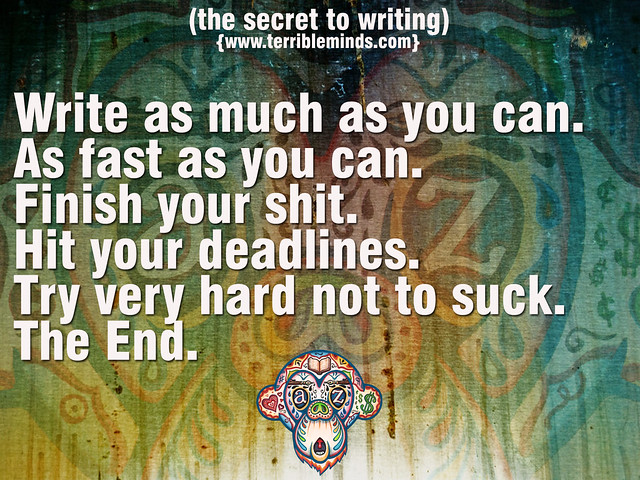
And here’s Chuck’s secret to writing:

source (re-sized here, and he did register it with a Creative Commons license, so share away!)

Dude, where’s your story?

Hi, peeps–

Hope everything finds you groovy. I’m currently working on my latest novels. One is the third installment of my science fiction series and the other is the fourth book in my New Mexico mystery series. And I like to keep up with blogs that offer tips and writing hints/fun stuff for authors. To that end, this post by writing guru Lisa Cron over at Writer Unboxed has some excellent advice.

The post, titled “The Biggest Mistake Writers Make and How to Avoid It,” notes that STORY is the crapfall for writers. That is, many writers don’t know what that is or how it works within the framework of their plot. You’re scoffing. But wait. Hear Lisa out.

So even though they have a great idea and their prose is gorgeous, there’s no story, thus no sense of urgency, and ultimately, no reader. It’s as simple – and heartbreaking – as that. And it’s extremely common.
(from “Biggest Mistake“)

Does that make sense? Really think about that. No story = no sense of urgency. Lisa tells us that THIS is what her definition of a story is:

A story is how what happens (the plot) affects someone (the protagonist) in pursuit of a difficult goal (the story question) and how he or she changes as a result (which is what the story is actually about).
{from “Biggest Mistake”)

A story, she says, is not about the plot. It’s about how the plot affects the protagonist. It’s thus INTERNAL, not external.

Thus, first and foremost, a story is about how the protagonist makes sense of what happens, and how she then reacts as she pursues her goal. In short, it’s not about what she does, it’s about why she does it.
(“Biggest Mistake”)

Cron then notes 5 reasons that can make your story go astray. I’ll give you Point 3, here:

3. Good novels very often trick us into believing that the writer never ventured into the protagonist’s mind, when in fact, that’s where the story unfolded.

Pull just about any novel off your shelf and look specifically for how the writer is conveying the protagonist’s internal reaction to what happens; you’ll see it everywhere. When reading for pleasure it’s nearly invisible, precisely because it’s how the novel gives us the sense that we’re in the protagonist’s skin. That’s why it’s maddening that writers are often warned not to include internal thought. Why is this advice given? Because when done poorly, internal thought can turn into long, rambling, irrelevant monologues that derail a story. So the best advice is simply this: learn to write internal thought well. After all, it’s what lets us know how the protagonist is really responding to what’s happening, and that’s where the power of story lies.
(“Biggest Mistake”)

Author Joan Opyr and I had a conversation about writing and writing styles a while back. She observed that good writing and good structure means that a reader is caught up in the reading. She said it’s when all the moving parts work seamlessly together. When they don’t — when there’s a little hiccup or a grinding of the gears — that means the novelist missed something in the telling of the story.

I struggle with story myself, and I know I’m not the only author out there who does. Cron leaves us with this advice: “. . .in the beginning, it’s all about nailing the story. When you get to that last draft (which will most likely be many drafts away), it’s about polishing the prose.”

Good reminder. Thanks, Lisa.

Happy reading, happy writing!

On health and happiness

Hi, all–

Been busy ’round here. If you haven’t yet, you might want to cruise over to Women and Words, especially on Fridays, because the summer blast tour is going on with several authors. On a whole bunch of Fridays, I’ll be chatting with different authors who write LGBTQ fiction. Most of them are doing book giveaways, as well, so you might score some new reading material. So far, I’ve chatted with Renée Bess, Lynette Mae, and Kate Mclachlan. And there are more to come! So come on by and hang out!

Anyway, I caught this blog by author Tracy Cooper Posey, who writes romance and paranormal/urban fantasy. In it, she offers 11 tips as to why authors should consider building and maintaining good health as those things relate to writing.

Interested about my take on links between health and happiness? Read on…

Continue reading

Finding your fiction in nonfiction

Hey, folks–

I read a lot of different stuff, all the time. Part of my regular reading material is nonfiction, not just because it’s interesting but because real life provides a lot of interesting story ideas. Especially since I write genre fiction. So here are a few articles I’ve recently read that maybe you’ll find give you some ideas. Especially if you write genre fiction, too.

The Vanishing,” by Bob Briel, Outside (July 2012)
In the stunning and remote wilderness along northern British Columbia’s Highway 16, at least 18 women — by some estimates, many more — have gone missing over the past four decades. After years of investigation, authorities still don’t know if it’s the work of a serial killer or multiple offenders. BOB FRIEL drives into the darkness for answers.

I’m also a huge fan of travel writing. Try this one (winner of the bronze Solas award, by the editors of Travelers’ Tales):
Letting Go on the Ganges,” by Kristin Zibell
A recently divorced woman finds endings and beginnings in India.

Mexico Feeds Me: Exploring Mexico’s Culinary Heritage,” by Javier Cabral (Saveur, first published in issue #138)
In rural Zacatecas, Mexico, a young writer explores his heritage by cooking the rustic, boldly flavored dishes of the region.

I’m also a westerner born and bred, so I’m a sucker for a western-flavored essay.
West to East, and a world away,” Charles Finn (Writers on the Range, in High Country News, February 17, 2012)
After 20 years in the West (and he’s come to love it), a writer has to go back East.

And maybe something you didn’t think you’d ever WANT to think about: Jailhouse food.
An Insider’s Guide to Jailhouse Cuisine,” by Sean Rowe (Oxford American [the Southern Magazine of Good Writing], originally appeared in Issue 61, The Oxford American Best of the South issue, 2008)
The author spends time in jail, and offers us this slice of life in the big house and the role of food therein.

So there you are, peeps. Maybe you’ll find some…ah…food for thought in some of these pieces and BOOM the next plot for your next novel will hit you.

Happy writing, happy reading!

Can you relate?

I might officially be an anachronism.

I’m still using a flip phone, and I don’t use it to access the web. I actually dial people’s numbers and TALK to them. Oh, sure, I’ll text as well and send a few photos. But I mostly use it to TALK.

I’m Gen X, which means I’m an immigrant to the digital world. I grew up without the interwebs, without voicemail (or answering machines), without cable, without cell phones, and without DVDs. VHS came along in the late 70s/early 80s, but most of us saw movies at the theater when they were released. (Oh, want more info about how primitive and weird things were for my generation? Here.)

I spent most of my summers outdoors with friends, or we got together at each other’s houses. We’d call each other on landlines and if nobody answered, we figured he or she was busy and we’d call back later. Or, if they did have answering machines, we’d leave a message. Eventually, we’d catch up with each other. No big deal if it took a few hours. Or a day or two. We all had other things to do. We’d meet up at various hangouts and get caught up on rumors, gossip, and plans for the upcoming days.

Point being, we TALKED. Face-to-face and on the phone.

That, I think, is becoming a lost art.

Want more? Keep reading…

Continue reading

Time warps and writing

Hiya, peeps–

If you haven’t strolled down 80s lane with me and you’d like to, pop on over to Women and Words. Because I totally went on a nostalgia tour.

One of the comments over there mentioned Armistad Maupin’s work, and yes, I’ll concur. His first Tales of the City captured a particular era and community at a critical juncture in its history. I mentioned several movies that might have some of you walking down your own nostalgic road. Unless you were born AFTER the era, in which case, it’s a great historical lesson, especially if you want to set any of your writings in the 80s. 😀

And that led me to THIS thought. No interwebs, no smart phones (and very few mobile phones), not much by way of cable TV, VHS, and satellite TV dishes nearly the size of the ones at the VLA. OMG how DID we survive? Easily. Because that’s how things were. Those of us who came of age in that era are thus immigrants to the digital world, as opposed to the younger generations who were born into it/with it. Those folks don’t know what it is to NOT have the interwebs and mobile/smart phones. So think about how technology and what’s available figures into plots and characters.

Here’s what I mean by that.

So that’s how a jog down memory lane made me think about writing.

Happy weekend!

Common writing boo-boos

Hi, kids!

OMG before I get into some really common spelling/grammar boo-boos, I simply must share with you my latest snack craze. Holy cow, these things are good:


source: Blue Diamond (re-sized here)

Serious yum-yum.

Anyway. Where were we? OH! I’m going to list a few of the most common boo-boos I see in writing. Care to see? Well, carry on!

Continue reading