Sunday and the reading’s kinda fun

Hey, all–

FIRST! Check out this podcast of me chatting with the awesome folks over at the Bar Rag. WOOO!

Okay. Moving along.

As some of you may have already ascertained, I’m one of those weird apocalyptic types how is endlessly fascinated by human interaction with various end-of-the-world or natural disaster scenarios.

So thank the stars for Outside Magazine, which seems to have picked up on my weirdness and offered this piece on how to at least try to survive various disaster scenarios. No tips on zombies, but that’s okay. These might be far more relevant.

So here you go. Outside’s “The Apocalypse Handbook.” It includes survivors’ accounts of things that have happened (and they’re not always pretty).

Some of you may live in areas that these scenarios affect. Might be a good idea to get your survival kit ready and know what to do if something scary happens.

Happy reading!

Do some readin’!

Hi, peeps–

Just wanted to pass along a groovy reading tip. I’m a little late to this party (this book was published in 1997), but I highly recommend Barbara Hambly‘s A Free Man of Color, which is a murder mystery set in 1833 New Orleans (right around Mardi Gras). This is the first in this series. The main character is Benjamin January (or Janvier, as the French and Creole New Orleans residents call him), a free man of color, whose stepfather freed him upon his death.


source

Want more? Keep on clickin’…

Continue reading

Readin’ tip

Hi, kids. Back from my stint with the French Resistance. Now I have a bad accent, a removable goatee, a beret, and I like wine and cheese more than I did before.

Anyway, here’s a reading tip for you. I just finished a book by author/journalist Erik Larson. It’s his latest, titled In the Garden of Beasts: Love, Terror, and an American Family in Hitler’s Berlin, and it describes Nazi Germany during 1933-1934, when Hitler was still maneuvering to get more power. Hindenberg (the prez) was still alive, and Hitler’s position as Chancellor was still relatively new.


source

Larson centers the story on the American ambassador to Germany, William Dodd, a history prof at the U of Chicago. Roosevelt sent him over (Dodd was not the first choice), and he and his family are immediately caught up in the rapid changes of German society as the Nazis increased their hold over many aspects of daily life, politics, and press. The anti-Semitic laws started slowly, but what’s fascinating here is that other countries were well aware of Hitler’s anti-Semitism, and well aware of his encroaching fanaticism but everyone played an appeasement game with him, operating under the assumption that beneath the fanaticism was a logical leader.

Therein was the mistake. Dodd was fiercely unpopular because he refused to play the diplomatic game and he was not fooled by Hitler — he didn’t live extravagantly, didn’t suffer fools lightly, and spoke frankly to Nazi officials (including Hitler) with whom he interacted. Nevertheless, the Roosevelt administration refused to acknowledge Dodd’s warnings about the rise of Hitler and the latter’s pushing Germany into a new war. When Dodd was relieved of his post and returned to the US, he spent time during the late 1930s working with an anti-Nazi propaganda organization and giving speeches all over the country about the dangers of Hitler’s Germany and the fact that Hitler was maneuvering to invade Czechoslovakia and other Eastern Bloc countries. In 1939, his warnings proved prescient, when Hitler invaded Poland and the world again descended into world war.

This is a superb look at how easy it is to insinuate a nationalistic, violent, and dangerous ideology into a country that is reeling from economic and social stresses. It starts slowly, with a few laws passed here and there outlawing certain things (like abortion, for example — the Nazis outlawed abortion among “Aryans”), and a collusion between corporate interests and government. Soon, the press is a tool of the government. And soon, certain classes of people are targeted as enemies of the state. And soon the disappearances of perceived political enemies begins, with government double-speak and obfuscation. And by the time you wake up and realize what’s happened, it’s too late.

Though this book is ostensibly a view into history, I found some creepy parallels with the current situation in the US. The collusion of corporate and government interests; the buying of elections; dismantling of unions and collective bargaining; cries against public education and federal aid; political candidates who trumpet a mean-spirited and exceptionalist agenda (“our way or the highway”; “we are called by God to do these things”, e.g.); a giant corporate news entity that touts a particular party and thus ideological line; the positioning of certain people as enemies of if not the state, the American way: LGBT people, immigrants, and Muslims in the current climate. That plus the wholesale mean-spiritedness of what passes today for press coverage mimics what passed for Nazi press 70 years ago.

Larson is a fabulous writer. I’ve read almost all his other stuff, and he injects a prescience into this story that really creeped me out. In addition, I didn’t know much about the diplomatic corps during Hitler’s rise to power, and learning about William Dodd — a man who was so, so right — was a real treat. It’s a fast read, and if you’re up for a little bit of comparison of historical eras, it might prove unsettling.

Happy (or at least, interesting) reading!

Awesomely cool writing tip

This comes from one of my fave bloggers and writer-guys, Chuck Wendig. He can be a little raunchy with the tips, but he’s always right on.

This week, Chuck enlightens us with 25 tips for writing dialogue, and I gotta tell you. I think dialogue can make or break a character, pacing, and a story. Here are some of MY thoughts on that.

What I really like about Chuck’s tips here is that he nails the importance of good dialogue and its role in plot. Here’s a taste:

3. Sweet Minimalism
Let’s get this out of the way: don’t hang a bunch of gaudy ornaments upon your dialogue. In fiction, use the dialogue tags “said” and “asked” 90% of the time. Edge cases you might use “hissed,” “called,” “stammered,” etc. These are strong spices; use minimally. Also, adverbs nuzzled up against dialogue tags are an affront to all things and make Baby Jesus pee out the side of his diaper, and when he does that, people die. In scripts, you don’t have this problem but you can still clog the pipes with crap if you overuse stage directions. Oh, heavy dialect and sland? Just more ornamentation that’ll break the back of your dialogue.

6. Shape Determines Speed
Short, sharp dialogue is a prison shiv: moves fast ’cause it’s gotta, because T-Bone only has three seconds in the lunch line with Johnny the Fish to stitch a shank all up in Johnny’s kidneys. Longer dialogue moves more slowly. Wanting to create tension? Fast, short dialogue. Want to create mystery? Longer, slightly more ponderous dialogue. Want to bog your audience in word treacle? Let one character take a lecturing info-dump all over their heads.

And there are 23 more, just waiting for you to peruse
RIGHT HERE.

Happy writing, happy reading!

Independence Day, U.S., and reading tips

Hi, folks–been kinda crazy here. Didn’t get to a zombie tip this week, but I DID watch the movie Zombieland again. Love Woody Harrelson’s character. You can tell he had a hell of a good time with that role.

At any rate, I know a lot of folks are doing the long weekend stay-cation thing (and maybe vacation, if you can afford it). But also keep in mind what this holiday’s all about. It ain’t about shopping, or buying new furniture, or retail sales. If you’ve got kids, remind them why we observe this holiday. It ain’t just a nice weekend to have a nice BBQ on.

I’ll help with that. Read on…

Continue reading

JD Glass rocks! And she’s got a new project!

Hi, kids–

Detracting from my Saturday apocalyptic ramblings to let you know about a super-cool project from JD Glass, the ultra-cool and edgy writer of books like American Goth and Punk and Zen.
 

source: Bold Strokes Books

JD is a modern-day Renaissance woman. Not only does she write (she’s a 2006 Lambda Literary Awards finalist), but she’s also the lead singer in the band Life Underwater AND she’s an artist of the drawing variety. She’s also an EMT. See what I mean? JD is one of the hardest-working women in and out of showbiz, and probably one of the nicest people I’ve had the good fortune to meet. She’s also got a ragingly cool new project in the works.

If you’re not familiar with her writing, check out Punk and Zen, which is a great lead-in to her latest project, called Core, a rock n’ roll novella with the soul of a graphic novel and the heart of a garage band.

source: Outlines Press

I have this feeling that you’re going to want to check this out, because what it does is what a really cool DJ mix does: two seemingly disparate elements seamlessly fused together into one helluva performance reading experience. Reading and looking through Core is like going to see your fave punk band at New York’s CBGB back in the day, when you wore your leather biker jacket and your black Converse high-tops with your skinny jeans and ripped Ramones shirt and you freakin’ spazzed your head near the stage, screaming “I Wanna be Sedated” at the top of your lungs. It’s your favorite artsy postcards taped right next to your concert ticket stubs, a novella/scrapbook/picture book that I guarantee will make you dig in your closet for your Converse and Wayfarer shades.

You can pre-order your copy now, via PayPal.

And for those about to rock, I salute you!

Fun reading

Hey, folks. If you get a chance, start reading Janet Evanovich‘s Stephanie Plum series.

Plum’s in Trenton, NJ (so get ready for a slew of Jersey references and jokes). She’s half-Italian, half-eastern European (not sure which country), and she’s one big lovable screw-up who ends up working as a bail bondsman for her cousin, Vinnie. With an uproarious cast of secondary characters like Lula, the prostitute-turned sober file clerk at Vinnie’s to Stephanie’s completely off-the-wall Grandma Mazur whose regular hobby is attending viewings, you will laugh out loud through every single one of these books.

From the second book, Two for the Dough (1996):

“They had a closed casket all right for Moogey Bues,” my grandmother said to my mother. “I got to see him anyway on account of the accident.”
My mother’s eyes opened wide in alarm. “Accident?”
I shrugged out of my jacket. “Grandma caught her sleeve on the lid, and the lid accidentally flew open.”
My mother raised her arms in appalled supplication. “All day I’ve had people calling and telling me about the gladioli. Now tomorrow I’ll have to hear about the lid.”
“He didn’t look so hot,” Grandma Mazur said. “I told Spiro that he did a good job, but it was pretty much a fib.”
Morelli was wearing a blazer over a black knit shirt. He took a seat, and his jacket swung wide, exposing the gun at his hip.”
“Nice piece!” Grandma said. “What is it? Is that a forty-five?”
“It’s a nine-millimeter.”
“Don’t suppose you’d let me see it,” Grandma said. “I’d sure like to get the feel of a gun like that.”
“NO!” everyone shouted in unison.
“I shot a chicken once,” Grandma explained to Morelli.
I could see Morelli searching for a reply. “Where did you shoot it?” he finally asked.
“In the gumpy. Shot it clear off.”
(pp. 63-64)


If you’re a writer of fiction, Evanovich’s characters and characterization often carry a lot of her narratives. Want to get a taste of what great characterization is? Read the Stephanie Plum series.

All rightie, happy reading and happy writing!

Oldies but Goodies

Hey, peeps–

Handy Sunday reading tip for you here: read books that are older than you. WAY older. Why? Because books are guideposts to history. Like art, they’re reflections of the historical contexts in which they were written. Authors are products of their historical contexts, as well, and of their cultural and geographical environments. Writers capture their surroundings, whether they write fiction or nonfiction, and through older books, you can get a snapshot of cultural and sociopolitical moments that play into larger trends and patterns.

So, given our current situation, with rampant corporate corruption and greed and how profit-driven mentalities can affect and hurt every one of us, have a look at Upton Sinclair’s The Jungle.

This is the 1906 cover:

source

Upton Sinclair was a muckracking journalist, and spent time undercover in 1904 in Chicago’s meatpacking plants. The results of his investigation were first published in serial form in Appeal to Reason, a Socialist newspaper. [before you get all bent out of shape, check this definition of Socialism.] What he saw in the plants will turn many stomachs still — the unsanitary and horrible conditions in which American meat is butchered and packed. But Sinclair also revealed the horrific conditions in which the workers at these plants toiled, and the circumstances of their lives and the industries in which they worked that kept them virtually enslaved.

As a result of this book, sweeping changes were made to the meatpacking industry to safeguard the health and safety of consumers and workers (Food and Drug Act, anyone?). However, Sinclair also wanted to draw attention to American poverty, the treatment of immigrants, and how the lack of social programs hurt not only workers, but a wider array of Americans. This book demonstrates how corporate (and government) corruption and wage slavery damage the so-called American dream and the economic foundations of this country. Sinclair shined a light on the dark side of capitalism, and it’s not pretty. Unchecked corporate capitalism, he warns, benefits no one but the corporate and government elite. There is no “trickle-down.” There is only the haves, who keep getting more, and the have-nots, who keep getting screwed.

So read it and see if you notice any similarities between what’s going on now and what went on just over a hundred years ago. I think you’ll be surprised.

Happy reading, happy writing, happy thinking!

Zombie Apocalypse lore

Okay, so maybe it’s not quite “lore” in the classic sense of the word, but it IS a quirky tale of “life” during the ZA, as captured in haiku by someone who is turning into a zombie and then becomes a zombie.

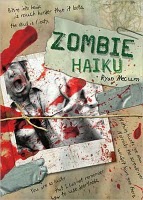
This clever documentation of the ZA is Zombie Haiku, by Ryan Mecum, published in 2008 by How Books.

source

Zombie Apocalypse via haiku. Who knew how much fun this could be? For those who don’t know what a haiku is, it’s a form of poetry that is three lines, each line with a designated number of syllables. In this case, 5-7-5. That is, 5 syllables in the first line, 7 in the second, and 5 in the third.

So a lovely zombie haiku from the cover of this book is:

Biting into heads
is much harder than it looks.
the skull is feisty.

source: cover of Zombie Haiku

The premise of this collection is clever, as well. It starts with a few lines of description of a survivor of the ZA. He originally started the poetry journal as a way to “capture the beauty of the world” through haiku. But then along comes the ZA and he writes hastily: “To whoever might find this, my name is Chris Lynch, and I’m pretty sure I’m dying. In face, if you are reading this, then I’m probably already dead. Not that anyone will be around to read this…from what I’ve seen, I’d guess this is the end of everything.” So as you start reading the haikus he’s written, it starts out all happy happy joy joy and then you notice he’s documenting the ZA, though he’s not aware that this is the case. He haikus about something in the news that says people are acting weird, but he turns if off. Then,

As I start my car,
my neighbor just keeps staring
and doesn’t wave back.

(p. 7)

He doesn’t realize, even with all the car wrecks and traffic and “drunk guy stumbling into traffic” what’s up. He gets to work, nobody’s there and one of his coworkers is “eating spaghetti in her car without utensils” and she smashes her head through the glass and tries to grab him, with glass sticking out of her neck. Anyway, our hero ends up not so lucky, and in the hands of a zombie mob. You see his metamorphosis through his clever haikus:

My skin is drying,
my veins are much ore pronounced
and I’m turning gray.

(p. 30)

one thing on my mind,
only one thing on my mind.
I’m going to eat you.

(p. 32)

Somehow, this zombie haikus being a zombie, and the illustrations and “dirt” and “blood smears” on the pages only add to the macabre, dark, hilarious fun in this book. The author’s handwriting morphs, too, and you end up seeing the world through the eyes of a zombie, whose haikus are short and sharp, like the staccato bursts of gunfire and the single-minded focus of an eating machine, which is what zombies are.

A seriously fun, clever, and wonderfully twisted book. See the ZA through a zombie’s eyes!

Happy reading, happy surviving!

Cool “writers on writing” archive

Hi, folks–

I took Monday off. Kind of a Manic Monday, don’tcha know.

Anyhoo, I came across this really sweet New York Times archive. It’s called “Writers on Writing” and it’s a big ol’ list of articles done by various writers that addresses some aspect of writing. Super cool.

How about E.L. Doctorow on how novels are following films into a land of “fewer words”?

As more than one critic has noted, today’s novelists tend not to write exposition as fully as novelists of the 19th century… .The 20th-century novel minimizes discourse that dwells on settings, characters’ CVs and the like. The writer finds it preferable to incorporate all necessary information in the action, to carry it along in the current of the narrative, as is done in movies.
source

Or Annie Proulx (whose work I deeply admire), on inspiration?

A whole set of metaphoric shovels is part of my tool collection, and for me the research that underlies the writing is the best part of the scribbling game. Years ago, alder scratched, tired, hungry, and on a late return from a fishing trip, I was driving through Maine when a hubbub on the sidewalk caught my eye: milling customers at a yard sale. I stop for yard sales. Pay dirt. I found the wonderful second edition unabridged Webster’s New International Dictionary with its rich definitions and hundreds of fine small illustrations.
source

Or Alice Walker on meditation, John Updike on character, or Carl Hiaasen on plagiarizing from real life?

This archive is a treasure trove of gems from a variety of writers, from a variety of perspectives. Seriously check it out.

Happy reading, happy writing!