Tips on writing stronger characters

Hi, all–

Usually on Sundays I provide some reading material or share with you a title of an article or book I’m reading. But since I am a writer, I also like to share tips for those of you who, for whatever reason, thought being a writer was a good idea. Welcome to my circus! I thought it was a good idea, too! LOL

Anyway, since we’re on this journey together, here are a couple of articles from Writer’s Digest that might help you create stronger, more nuanced characters. Plus, there’s another link to a blog that fellow writer Clifford Henderson did on it. And readers, if you ever read something and the writer makes it look easy, I hope you can appreciate the amount of work that went into that tract. Because it’s when everything’s working properly and smoothly that you know it’s the best kind of writing. Most writers work hard to achieve that — I don’t know if I have, yet, but dang it, I keep trying.

Want some more?

Continue reading

Quickie Writer Tip!

Hi, all!

As an editor, I see a ton of manuscripts, mostly fiction these days. The fun of editing a new author is watching them develop their own style within the framework of writing.

One of the things that many of the beginners I work with is that they have a problem ending chapters effectively.

I have two suggestions: 1) keep your chapters about the same length, which forces you to really think about scenes and pacing and 2) make sure your characters’ business is finished in that chapter before you break for a new one. That is, you want your reader to feel satisfied, as if something was happened and reasonably resolved or at least reasonably explained before sending them to a new chapter.

Aaron Elkins has a good piece over at Writer’s Digest to help you with “chaptering.”

Here’s the link!

Happy writing!

Sunday in Seattle (I wish…)

Hi, all–

I am a huge fan of Seattle. The Pacific Northwest is one of my fave regions in this country, and I love visiting. Seattle has a great literary and arts scene.

If you’re a writer-type of spec fic — which I am — Clarion West runs an awesome workshop. Here’s some skinny:

The mission of Clarion West is to provide a high quality educational opportunity for writers of speculative fiction at the start of their careers.

Speculative fiction (science fiction, fantasy, horror, magic realism, and slipstream) gives voice to those who explore societal and technological change along with deeper considerations of underlying archetypes of human experience. Clarion West brings new writers to the field of speculative fiction by providing a venue for a transformative experience in the form of a lengthy and intensive workshop focusing on literary quality, diversity of viewpoints, range of material, and other essential qualities.
source: Clarion West website

Clarion West is also doing a free readings series over the summer.

And because I also write mysteries, you MUST NOT leave Seattle without visiting the Seattle Mystery Bookshop. If you go, ask for Fran. She’ll hook you up with great recommendations and stories as well as local Seattle tips for food and drink. Tell her Andi sent you.

And, if you have time, see if you can catch a reading by Gina Ranalli, a horror/bizarro writer who’s one of my faves in the genre. She’s a local up there, and does events on occasion. Tell her Andi recommended you check out her books.

Oh, and because I’m a freaking music fanatic, stop in at the Experience Music Project museum, which blends creative innovation, technology, and pop culture/music. Awesome.

And yeah, if you’ve never been to Seattle, swing by the Pike Place Market and take a ride up into the Space Needle. TAKE YOUR CAMERA. The views from the Needle are freaking unbelievable. I was at the Pike Place Market a few years back and my shoulder was bugging me from god-knows-what and ta-da the Market had an acupuncturist available and he fixed me right up. Maybe take one of these awesome tours — ghost or true crime (the Pacific Northwest has an…um…interesting true crime history).


source

Anyway, you can find or see just about anything at the Market. The last time I was there, fellow author Joan Opyr and I managed to end up in a crowd of people intensely interested and sort of tailing after a lesbian BDSM lite couple through the market, dressed in full S/M vinyl regalia (and both looked like freakin’ models), one in red, one in black. One had a studded collar around her neck, the other held the leash. Serious stiletto heel boots. Our conversation went like this:

ME: “Those are great outfits. Seriously.”
JOAN: “I like how they match.”
ME: “The heels on those boots could do some serious damage if she stepped on somebody’s foot. They’re probably also good for squishing bugs in corners.”
JOAN: “Takes real skill to walk in those things. Or wield them like weapons.”
ME: “Takes real skill to dress in that. I’d be better off painting myself red than trying to get in there.”
JOAN: “I’d paint myself black and then we could go out clubbing with them.”
ME: “Cool. But in this town, nobody would notice.”

I freaking LOVE Seattle.

All rightie, happy writing, happy reading, and happy traveling!

Oldies but Goodies

Hey, peeps–

Handy Sunday reading tip for you here: read books that are older than you. WAY older. Why? Because books are guideposts to history. Like art, they’re reflections of the historical contexts in which they were written. Authors are products of their historical contexts, as well, and of their cultural and geographical environments. Writers capture their surroundings, whether they write fiction or nonfiction, and through older books, you can get a snapshot of cultural and sociopolitical moments that play into larger trends and patterns.

So, given our current situation, with rampant corporate corruption and greed and how profit-driven mentalities can affect and hurt every one of us, have a look at Upton Sinclair’s The Jungle.

This is the 1906 cover:

source

Upton Sinclair was a muckracking journalist, and spent time undercover in 1904 in Chicago’s meatpacking plants. The results of his investigation were first published in serial form in Appeal to Reason, a Socialist newspaper. [before you get all bent out of shape, check this definition of Socialism.] What he saw in the plants will turn many stomachs still — the unsanitary and horrible conditions in which American meat is butchered and packed. But Sinclair also revealed the horrific conditions in which the workers at these plants toiled, and the circumstances of their lives and the industries in which they worked that kept them virtually enslaved.

As a result of this book, sweeping changes were made to the meatpacking industry to safeguard the health and safety of consumers and workers (Food and Drug Act, anyone?). However, Sinclair also wanted to draw attention to American poverty, the treatment of immigrants, and how the lack of social programs hurt not only workers, but a wider array of Americans. This book demonstrates how corporate (and government) corruption and wage slavery damage the so-called American dream and the economic foundations of this country. Sinclair shined a light on the dark side of capitalism, and it’s not pretty. Unchecked corporate capitalism, he warns, benefits no one but the corporate and government elite. There is no “trickle-down.” There is only the haves, who keep getting more, and the have-nots, who keep getting screwed.

So read it and see if you notice any similarities between what’s going on now and what went on just over a hundred years ago. I think you’ll be surprised.

Happy reading, happy writing, happy thinking!

Zombie Apocalypse lore

Okay, so maybe it’s not quite “lore” in the classic sense of the word, but it IS a quirky tale of “life” during the ZA, as captured in haiku by someone who is turning into a zombie and then becomes a zombie.

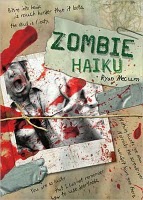
This clever documentation of the ZA is Zombie Haiku, by Ryan Mecum, published in 2008 by How Books.

source

Zombie Apocalypse via haiku. Who knew how much fun this could be? For those who don’t know what a haiku is, it’s a form of poetry that is three lines, each line with a designated number of syllables. In this case, 5-7-5. That is, 5 syllables in the first line, 7 in the second, and 5 in the third.

So a lovely zombie haiku from the cover of this book is:

Biting into heads
is much harder than it looks.
the skull is feisty.

source: cover of Zombie Haiku

The premise of this collection is clever, as well. It starts with a few lines of description of a survivor of the ZA. He originally started the poetry journal as a way to “capture the beauty of the world” through haiku. But then along comes the ZA and he writes hastily: “To whoever might find this, my name is Chris Lynch, and I’m pretty sure I’m dying. In face, if you are reading this, then I’m probably already dead. Not that anyone will be around to read this…from what I’ve seen, I’d guess this is the end of everything.” So as you start reading the haikus he’s written, it starts out all happy happy joy joy and then you notice he’s documenting the ZA, though he’s not aware that this is the case. He haikus about something in the news that says people are acting weird, but he turns if off. Then,

As I start my car,
my neighbor just keeps staring
and doesn’t wave back.

(p. 7)

He doesn’t realize, even with all the car wrecks and traffic and “drunk guy stumbling into traffic” what’s up. He gets to work, nobody’s there and one of his coworkers is “eating spaghetti in her car without utensils” and she smashes her head through the glass and tries to grab him, with glass sticking out of her neck. Anyway, our hero ends up not so lucky, and in the hands of a zombie mob. You see his metamorphosis through his clever haikus:

My skin is drying,
my veins are much ore pronounced
and I’m turning gray.

(p. 30)

one thing on my mind,
only one thing on my mind.
I’m going to eat you.

(p. 32)

Somehow, this zombie haikus being a zombie, and the illustrations and “dirt” and “blood smears” on the pages only add to the macabre, dark, hilarious fun in this book. The author’s handwriting morphs, too, and you end up seeing the world through the eyes of a zombie, whose haikus are short and sharp, like the staccato bursts of gunfire and the single-minded focus of an eating machine, which is what zombies are.

A seriously fun, clever, and wonderfully twisted book. See the ZA through a zombie’s eyes!

Happy reading, happy surviving!

Cool “writers on writing” archive

Hi, folks–

I took Monday off. Kind of a Manic Monday, don’tcha know.

Anyhoo, I came across this really sweet New York Times archive. It’s called “Writers on Writing” and it’s a big ol’ list of articles done by various writers that addresses some aspect of writing. Super cool.

How about E.L. Doctorow on how novels are following films into a land of “fewer words”?

As more than one critic has noted, today’s novelists tend not to write exposition as fully as novelists of the 19th century… .The 20th-century novel minimizes discourse that dwells on settings, characters’ CVs and the like. The writer finds it preferable to incorporate all necessary information in the action, to carry it along in the current of the narrative, as is done in movies.
source

Or Annie Proulx (whose work I deeply admire), on inspiration?

A whole set of metaphoric shovels is part of my tool collection, and for me the research that underlies the writing is the best part of the scribbling game. Years ago, alder scratched, tired, hungry, and on a late return from a fishing trip, I was driving through Maine when a hubbub on the sidewalk caught my eye: milling customers at a yard sale. I stop for yard sales. Pay dirt. I found the wonderful second edition unabridged Webster’s New International Dictionary with its rich definitions and hundreds of fine small illustrations.
source

Or Alice Walker on meditation, John Updike on character, or Carl Hiaasen on plagiarizing from real life?

This archive is a treasure trove of gems from a variety of writers, from a variety of perspectives. Seriously check it out.

Happy reading, happy writing!

You. Must. Chill.

All right, this week has been crazy scary busy for me. One thing after another and deadlines and freakiness and…like that.

So tonight, I’m passing along a message that I used to tell my college-aged students when I was teaching. It was kind of a challenge I issued to them, if only because them crazy youngsters come out of the womb with electrical, not umbilical cords. I’d tell them this:

Be Amish for a week. Or at least a weekend (no disrespect at all to Amish people).

That is, unplug. Turn off your TV and computers. All your electronic devices. Leave your phone at home. Don’t drive anywhere. Or, better yet, do drive somewhere out of reach, like a cabin in the middle of nowhere with no internet connection and no TV.

Learn how to be with yourself, without the distractions of electronic devices that so many people today seem to define themselves either with or as. You are an individual, and healthy individuals need to spend time alone, without distractions, without obsessively checking email or text messaging. Get off the information superhighway and reconnect with your immediate surroundings, your family, your neighborhood.

And make this a habit. At least 1-2 evenings a week be tech-free (Amish). And extend it. You don’t need the constant mind-numbing bombardment of information, or the corporate-driven consumer drivel that makes you think you need things you really don’t. Turn it off. Build a community, build a true revolution that emphasizes individuals working in tangent with other unique individuals to oppose the brainless prattle that passes for “news” and “information” these days. Go to a library and read. Spend time with yourself, and spend face-time with people, rather than interacting via text and email.

Reconnect with nature. You need balance in your life, and being constantly plugged in to something techie is robbing you of real, sensory experiences.

So try it. Be Amish for a while. It could change your life.

Happy living!

Music to soothe the savage beast

Hey-dee how-dee.

I’m here to pimp a couple of my fave websites that stream music. I listen to music pretty much constantly, especially when I’m writing, and each project I work on requires a different kind of soundtrack, though I’ve found that trance music is providing a soundtrack for virtually anything I’m working on, much to my delight in some ways.

With that in mind, one of the best-kept secrets, I think, is Digitally Imported (electronica and everything like it). I’ve been listening to this site for at least three years now. I upgraded to the paid premium (about $5 a month and it’s well worth it), and turn that pup on and away it goes pretty much all day.

Another is Pandora, and I know some of you already listen to that and have created your own radio stations. One of the down sides — and I haven’t upgraded to a paying customer over there — is that the playlist on any particular station repeats after a while. Another pain in the butt is that in order to create a varied playlist, you have to constantly click that you “like” a particular song so Pandora remembers it and plays stuff like it. If you don’t click “like” for a while, Pandora will basically stop, because “it’s not sure you’re still listening.”

Another site I’ll use is 365Live, which offers virtually every genre under the sun. The site’s a little difficult to navigate, and because it basically just serves as kind of a clearinghouse, you have to click the station link to see if your player is compatible. But there are some truly great stations there, including world music, which is another of my faves.

AOL Music is offering free world music, speaking of. I haven’t really explored this site, but some of the genres are super cool.

And if you’re feeling totally new-agey or yoga-ish, Sky.fm has a New Age music stream. Super mellow.

One more tip–if you find a station you just love to death and you listen to it quite a bit, think about upgrading if it offers that option. No commercials, better sound, and you’re contributing to great music.

Happy listening!

Writing tip! A, B, Cs of plot development!

Hey, all–

Found this groovy writing tips site that includes this:

The ABCs (and Ds and Es) of Plot Development.

Here’s an excerpt:

Plot develops out of conflict, either external, such as a person or an event that precipitates a series of actions the main character undertakes, or internal, driven by the protagonist’s wants and/or needs. How that character, and others, makes choices and otherwise responds to stimuli determines the course of events.

The traditional structure of a plot is linear, in which the protagonist’s actions are charted in a more or less straight line, although many stories shift from that person’s point of view to that of one or more other characters as the tale progresses. Others involve one or more flashbacks, introducing new elements to the overarching plot.

Here’s the quick n’ dirty:
A = Action
B = Background
C= Conflict
D = Development
E = End

Go on and check it out.

Happy writing, happy reading!

Pondering

Hi, all–

Happy belated Cinco de Mayo! Anyway, I’ve been thinking about history (which is okay — I’m a historian, so I’m not practicing history without a license hee hee). And I’m thus going to direct you to my blogpost over at Women and Words today, which will show you the direction my ponderings took. It has to do with Pride season, just as a heads up.

Happy Friday!