What I learned about writing from zombie plots

Hi, kids–

So I’ve been following the series Walking Dead, as some of you know. It’s a zombie apocalypse series, and what I find interesting about it is how interpersonal human drama plays out against a backdrop like this.

In that regard, Walking Dead is what I’d call a mixture of Lord of the Flies, The Road Warrior, and Night of the Living Dead. Because ultimately, what apocalyptic and dystopic scenarios come down to is the people dealing with them, and the power struggles within the groups of survivors.

There’s no story in a zombie apocalypse if there aren’t non-zombies therein having to cope with it. And there’s no story in a dystopic society in which a tyrant rules all unless there’s a segment of the population battling that or thinking about battling it. Stories are all about conflict, whether internal or external.

So let’s go have a think about that, shall we? 😀

Continue reading

How-to writing books

Hi, kids–

One of the ironies of writing is that we tend to read other writers’ guides on how to write. And we should, because there are some really good writing guides out there. It’s important to have guides on hand to grammar and punctuation, guides that help us figure out infrastructure, and tips that we can implement in our own writing to take our games to the next level. And then there are inspirational writing guides that can make you feel warm and fuzzy after you’ve had writing issues.

So here are a few of my suggestions.

For mystery writers, check out Chris Roerden‘s Don’t Murder Your Mystery (that link will also show you another of her great guides, Don’t Sabotage Your Submission). The tips in that book you can use for other genres, as well.

Looking to write more descriptively? Try Rebecca McClanahan‘s Word Painting. It includes instruction and exercises, as well as examples from the masters, classic and contemporary.

Stephen King’s On Writing. It’s already on its 10th anniversary. Part memoir, part guide, this handy toolkit will address just about everything you need in your bag o’ writing tricks. The fundamentals, my friends. Plus, it’s a warm, intimate look at King’s early life and how he himself approaches writing. But don’t just listen to me. Go check out the link.

Natalie Goldberg, Writing Down the Bones (originally published in 1986, but it was updated in 2005). This is sort of a “Zen and the art of liberating your inner writer” kinda book. Might not be everyone’s style, but it’s a different approach and delves into creativity and its potential spiritual elements.

Strunk and White, The Elements of Style. It does not matter that this book first started life as an in-house writing guide for college students in 1918 by Cornell’s William Strunk. Nor does it matter that this pup got new life in 1959 when E.B. White revised Strunk’s 1935 edition. It’s freakin’ timeless, this book, and addresses things like the most misspelled words, common word usage errors, and proper punctuation. The book does have its critics, but it’s a nice brick to have in your writing framework.

Also get on over to Keith Cronin‘s recent blog over at Writer Unboxed to see his list of suggestions for writing guides. We overlap in a couple of places, but that’s okay. I like his list and I’m going to take his suggestions on a couple of things.

And here’s a list by Jon Winokur over at HuffPo (from 2010, but that’s quite okay).

Hopefully, that’ll get you started. Happy reading, happy writing!

Writing a mystery series: tips and timing

Hey, kids–

Hope this weekend treats you well. I’ve been thinking about series. That is, the series of books that authors write — usually in genre fiction like mystery or speculative fiction. In addition to my standalone short stories and novella-length stories, I write two series. One mystery, one sci fi.

Like many writers (most, probably), I have a day job, which means I have to really budget my time and make schedules so that I get writing time in as often as I can. I generally try to write every day, but some days, I’m really tired so I don’t. I don’t beat myself up about that, because trying to write when I’m tired means I’ll be doing lots of re-writing later, and if I’m just too tired, I can’t be present for the writing session.

Point being, because I have a day job and can’t devote 8 hours a day to writing, that means it’s hard to do that book-a-year thing that many series authors do. I also had a bunch of other issues crop up over the past year that required my full attention, so I had to back-burner (for a bit) both my series. I’m finishing up the third in the sci fi, and I’m over halfway through the fourth in my mystery series. So I’m playing catch-up. But that’s not really what was on my mind.

I recently saw the movie Looper (which is completely awesome though if you’re fragile in certain ways, it is very violent and there’s lots of cursing), and because there’s time travel involved, it got me thinking about that and other time conundrums. And that, in turn, got me thinking about series.


Source: Nova (re-sized here)

WTF, you say? Read on!

Continue reading

More things you shouldn’t do as an author

Hi, kids–quickie here.

Caught this article on HuffPo a couple days ago: “11 Things Not to Do Before Your Book Launch,” by M.J. Rose.

Most of these tips are pragmatic, like the first 2:

1. Don’t assume everyone will wake up the day your book comes out and rush out to buy it . (No one can buy a book they have never heard of.)

2. Don’t spend more than 10% of your marketing/pr budget on a trailer. Trailers have to be marketed too. So far too many authors wind up marketing their trailers instead of their books.

A couple deal with making sure you don’t trip over your ego, like number 5:

5. Don’t be in awe of your own talent, book, brilliance, success or transcendental prose. It’s better to have someone other than you, the author, praise the book.

I’d say those tips can apply to after the launch, as well, and should be things you’re thinking about anyway, in conjunction with every book you write and your overall writing arc. That is, where you want to go with your projects, both long-term and short-term goals.

And some tips about etiquette for authors I posted a while back, just as a refresher. Go here and here, if you wanna see.

Happy reading, happy writing!

More on the Writers’ Police Academy

Hey, kids!

Okay, so I’m able to get caught up with things and tell you about my weekend at the Writers’ Police Academy in North Carolina. I mentioned it a bit last week here. I’m a member of Sisters in Crime, which is so freaking awesome in so many ways, not least of which is helping subsidize the WPA registration fee for its members. BIG FREAKING SHOUT-OUT TO SinC! And THANK YOU THANK YOU THANK YOU to all the staff at the Guilford, NC sheriff’s department, who VOLUNTEERED all their time to work with us over the weekend, and to the instructors at Guilford Technical Community College, who also VOLUNTEERED their time to run the sessions and work with a bunch of writers who literally bombarded them with questions. THANKS!

So I’m gonna give you my day-to-day activities. So for those of you who write thrillers and/or mysteries, an event like this might be well worth your while.

Let’s go!

Continue reading

Writers’ Police Academy

Hey, kids!

Okay, so I had the super-cool chance to attend the Writers’ Police Academy this year.


source

I’ve been wanting to go, and this year I had the chance. So I did. I’ll talk more about it in a later blog, as I’m still trying to catch up after my almost 4 days of constant go go go. But I do want to make a few things clear in this blog. You’ll see those below.

Something that helped me immensely: As a member of the organization Sisters in Crime, my registration cost was $100. That was a giant bowl of awesome. Obviously, like other workshops, you have to arrange your own transportation and lodging (the conference hotel had a conference rate) and a few meals, but for things like this, it’s totally worth it, especially since workshop/conference registration can sometimes be super expensive for many of us, like $300-$500 in some cases. Nevertheless, try to save up so you can go. And professional organizations can help cut that cost a bit.

So let me stress the following points about events like this:

1. It’s important to continue to expand your horizons as a writer, and to continue to develop your skill set.

2. Workshops/conferences give you a chance to network. You never know who you’ll meet or what new avenues you’ll be able to explore.

3. Get the most out of your conference/workshop experience. Go to panels that not only interest you, but that have something to do with projects you’re working on. The people leading the panel and the audience are all not only interested in the topic, but working on projects that deal with it, too. Networking opp!

4. Talk to the instructors/people leading the panels. They can provide more information, direct you to even more resources, and become a potential contact.

And do yourself this favor:
5. Join professional organizations that cater to the type/genres of writing you do. Membership gives you perks, including deals on conference/workshop registration. They’re also great networking opportunities. And I recommend you share the love back, and give of your time and energy to the organizations as you can. They’re always looking for volunteers to help with projects. I cannot stress this enough. Join professional organizations. Keep current on your dues, utilize the resources, and make yourself known.

Next time, I’ll give you more of my experience at WPA. In the meantime, check out this schedule. That’s what I did from Thursday night through Sunday afternoon. For those of you who write thrillers and/or mysteries, Writers’ Police Academy is something you really need to think about doing. I’ll tell you more next time.

Happy Tuesday!

So you want to be a writer. Bless your heart.

Hi, folks–

I’ll be on the road in the next few days, so I won’t be able to check in as often as I’d like. But DON’T WORRY! I’ll be back, and probably with some tales to tell.

Anyway, I follow Broadside (because it’s an awesome blog. Hello.) and today, Caitlin Kelly (the woman who does Broadside) had a super good post about what it takes to be a writer. READ IT. Not that I’m pushing you or anything.

She didn’t use the term “stubborn,” but I sure will (Caitlin used “persistence”). Because that’s important. You must be stubborn and stick to it, if it’s what you want to do. And you must continue to do it, in the face of what some days feels like you’re wearing a pair of concrete cowboy boots in a shit tornado. In spite of these things, you must persevere, if this is what you want to do.

You will be rejected (and some of those will hurt). You will be dissed on the interwebs (and you must not respond). You will submit your work a gajillion times and only one of those times may garner you a notice. But it may not land you a contract. You must, as Caitlin points out, have a hide the thickness of a fossilized dinosaur’s (okay, she’s more eloquent) but the sensitive heart of a Bambi-eyed puppy. You must suck it up and smile, even when you’re in the middle of that poo typhoon, and exhibit graciousness and humility because people remember what you say and do. Readers like to know that you’re not some cranky-ass sodden heap of negativity spewing thunderbolts of judgment at everybody who wanders across your time/space continuum. And if you are, readers remember. Hell, everybody remembers. Why bring that on yourself?

And, a couple of my favorites from Caitlin: be curious, and be generous. I’m intensely curious about everything and everyone. How could you not be? The world is an endlessly fascinating place and we are a totally mondo-bizarro species doing all kinds of wild stuff. I also like giving of my time and energy to others, because you never know who you’ll meet. Plus, it’s just good ju-ju to share the love.

Caitlin also supplies some links to other blogs about what it takes to be a writer. Check those out. And here are a couple I liked.

(the always irreverent and happy sailor-mouthed) Chuck Wendig’s 25 things he wants to say to aspiring writers

And another Chuck post about things writers lie about to themselves

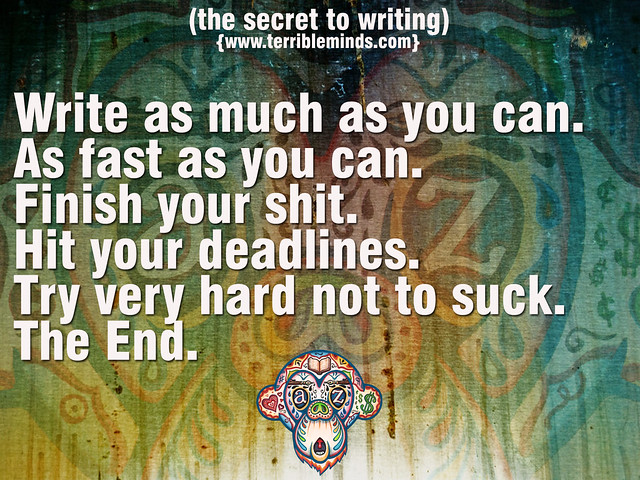
And here’s Chuck’s secret to writing:

source (re-sized here, and he did register it with a Creative Commons license, so share away!)

Dude, where’s your story?

Hi, peeps–

Hope everything finds you groovy. I’m currently working on my latest novels. One is the third installment of my science fiction series and the other is the fourth book in my New Mexico mystery series. And I like to keep up with blogs that offer tips and writing hints/fun stuff for authors. To that end, this post by writing guru Lisa Cron over at Writer Unboxed has some excellent advice.

The post, titled “The Biggest Mistake Writers Make and How to Avoid It,” notes that STORY is the crapfall for writers. That is, many writers don’t know what that is or how it works within the framework of their plot. You’re scoffing. But wait. Hear Lisa out.

So even though they have a great idea and their prose is gorgeous, there’s no story, thus no sense of urgency, and ultimately, no reader. It’s as simple – and heartbreaking – as that. And it’s extremely common.
(from “Biggest Mistake“)

Does that make sense? Really think about that. No story = no sense of urgency. Lisa tells us that THIS is what her definition of a story is:

A story is how what happens (the plot) affects someone (the protagonist) in pursuit of a difficult goal (the story question) and how he or she changes as a result (which is what the story is actually about).
{from “Biggest Mistake”)

A story, she says, is not about the plot. It’s about how the plot affects the protagonist. It’s thus INTERNAL, not external.

Thus, first and foremost, a story is about how the protagonist makes sense of what happens, and how she then reacts as she pursues her goal. In short, it’s not about what she does, it’s about why she does it.
(“Biggest Mistake”)

Cron then notes 5 reasons that can make your story go astray. I’ll give you Point 3, here:

3. Good novels very often trick us into believing that the writer never ventured into the protagonist’s mind, when in fact, that’s where the story unfolded.

Pull just about any novel off your shelf and look specifically for how the writer is conveying the protagonist’s internal reaction to what happens; you’ll see it everywhere. When reading for pleasure it’s nearly invisible, precisely because it’s how the novel gives us the sense that we’re in the protagonist’s skin. That’s why it’s maddening that writers are often warned not to include internal thought. Why is this advice given? Because when done poorly, internal thought can turn into long, rambling, irrelevant monologues that derail a story. So the best advice is simply this: learn to write internal thought well. After all, it’s what lets us know how the protagonist is really responding to what’s happening, and that’s where the power of story lies.
(“Biggest Mistake”)

Author Joan Opyr and I had a conversation about writing and writing styles a while back. She observed that good writing and good structure means that a reader is caught up in the reading. She said it’s when all the moving parts work seamlessly together. When they don’t — when there’s a little hiccup or a grinding of the gears — that means the novelist missed something in the telling of the story.

I struggle with story myself, and I know I’m not the only author out there who does. Cron leaves us with this advice: “. . .in the beginning, it’s all about nailing the story. When you get to that last draft (which will most likely be many drafts away), it’s about polishing the prose.”

Good reminder. Thanks, Lisa.

Happy reading, happy writing!

Super awesome blogs on freelance writing

Hey, all–

Broadside Blog (run by the awesome career journalist Caitlin Kelly) is doing a great series of blogs on freelance writing. Tips, suggestions, hows, whys, what it’s like, and excellent comments from readers.

So here.

“What’s freelance writing for a living really like?”
Introduces you to what it might be like to live that freelance writing life.

“The freelance writers’ life, continued”
Includes tips on ethics and networking.

“Negotiating — every freelancer’s challenge!”
Tips on how to do this.

Oh, and I’m throwing this one in, also from Broadside: “Twelve tips for fresh grads — includes a job offer!”

That one’s got good tips we can all use. Like these:

Take an hour every day unplugged from all forms of technology

Savor it. Your best ideas will come to you alone, in silence and probably while in the natural world. Do not tether yourself to Facebook or Tumblr clutching for some sort of emotional blankie.

Read challenging, smart material. Every day

It’s easy to think “Thank God. I’m done!” No more papers, tests, exams, finals. Just because you’ve snagged your diploma doesn’t mean it’s time to turn your brain off. Veg for a while, but make a point of reaching for some smart, tough work. If you’re an art history major, are you up on the (latest) banking scandal ? Do you know what Libor is? Read the business section of the Wall Street Journal and/or New York Times, the Financial Times if you’re really ambitious. If you’re an economics or political science major, take the time to read history, arts and literature. Throughout your life, and not just to get or keep a job, you need to keep broadening your horizons and stay sharp!

People tend to hire and promote people with insatiable curiosity and the ability to quickly analyze and sift through complex data.

Yeah. Good stuff. So go have a look at Broadside Blog and happy writing, happy reading!