Memorial Day

Hi, folks–

If you’re hanging out at home (maybe it got a little hot to do much on this Monday off), I recommend this book by Sebastian Junger:

War

source

The book accompanies a documentary called Restrepo, but if you’re not familiar with Junger’s writing, read this book. He is a master with phrasing, narrative, and sparse, gritty language that puts you right into the heart of whatever he’s describing. Here, Junger spent months shadowing an American infantry platoon in Afghanistan. Here’s a quote from a New York Times book review:

The best way to describe Junger’s book is to say what it is not. “War” does not attempt to explain the strategy behind the American war in Afghanistan, or the politics of Afghanistan, or even the people of the Korangal Valley. As the action unfolds, Junger makes no attempt to connect it to anything else happening inside the country.

Instead, he uses the platoon (the second of Battle Company, part of the 173rd Airborne Brigade) as a kind of laboratory to examine the human condition as it evolved under the extraordinary circumstances in which these soldiers fought and lived.
source, New York Times Review of Books, review by Dexter Filkins

Here’s a trailer from the documentary Restrepo, which won the 2010 Grand Jury Prize for documentaries at Sundance. My point? There is a reason we commemorate Memorial Day, regardless of your beliefs about war.

The language in this trailer is NSFW.


link
Zombie Apocalypse lore

Okay, so maybe it’s not quite “lore” in the classic sense of the word, but it IS a quirky tale of “life” during the ZA, as captured in haiku by someone who is turning into a zombie and then becomes a zombie.

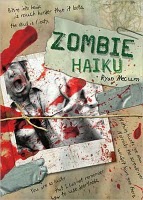
This clever documentation of the ZA is Zombie Haiku, by Ryan Mecum, published in 2008 by How Books.


source

Zombie Apocalypse via haiku. Who knew how much fun this could be? For those who don’t know what a haiku is, it’s a form of poetry that is three lines, each line with a designated number of syllables. In this case, 5-7-5. That is, 5 syllables in the first line, 7 in the second, and 5 in the third.

So a lovely zombie haiku from the cover of this book is:

Biting into heads
is much harder than it looks.
the skull is feisty.

source: cover of Zombie Haiku

The premise of this collection is clever, as well. It starts with a few lines of description of a survivor of the ZA. He originally started the poetry journal as a way to “capture the beauty of the world” through haiku. But then along comes the ZA and he writes hastily: “To whoever might find this, my name is Chris Lynch, and I’m pretty sure I’m dying. In face, if you are reading this, then I’m probably already dead. Not that anyone will be around to read this…from what I’ve seen, I’d guess this is the end of everything.” So as you start reading the haikus he’s written, it starts out all happy happy joy joy and then you notice he’s documenting the ZA, though he’s not aware that this is the case. He haikus about something in the news that says people are acting weird, but he turns if off. Then,

As I start my car,
my neighbor just keeps staring
and doesn’t wave back.

(p. 7)

He doesn’t realize, even with all the car wrecks and traffic and “drunk guy stumbling into traffic” what’s up. He gets to work, nobody’s there and one of his coworkers is “eating spaghetti in her car without utensils” and she smashes her head through the glass and tries to grab him, with glass sticking out of her neck. Anyway, our hero ends up not so lucky, and in the hands of a zombie mob. You see his metamorphosis through his clever haikus:

My skin is drying,
my veins are much ore pronounced
and I’m turning gray.

(p. 30)

one thing on my mind,
only one thing on my mind.
I’m going to eat you.

(p. 32)

Somehow, this zombie haikus being a zombie, and the illustrations and “dirt” and “blood smears” on the pages only add to the macabre, dark, hilarious fun in this book. The author’s handwriting morphs, too, and you end up seeing the world through the eyes of a zombie, whose haikus are short and sharp, like the staccato bursts of gunfire and the single-minded focus of an eating machine, which is what zombies are.

A seriously fun, clever, and wonderfully twisted book. See the ZA through a zombie’s eyes!

Happy reading, happy surviving!

I still have an attention span–hey! A new iPad!

Caught this Publishers Weekly post thanks to fellow author Lori Lake, via Sisters in Crime. It’s a lament about our dwindling attention spans. Click here.

Bill Henderson, one of the co-authors of the book Book Love, which celebrates the printed book, notes that our techie-oriented society is literally changing the structure of our brains:

The e-experts said that in the future all information and literature would be available on the device of the moment (sure to be replaced by the device of the next moment). You may never have to leave the comfort of home or bed. The latest bestseller—indeed, millions of out-of-print books (you didn’t know you needed that many)—could be had at the click of a button. This was billed as an improvement.

Lots of people are making lots of money telling us this is for our own good. Tweeting away, we never stop to think. In fact, we may be losing the ability to think.

In The Shallows: What the Internet Is Doing to Our Brains (Norton, 2010), Nicholas Carr notes that after years of digital addiction, his friends can’t read in depth anymore. Their very brains are changing, physically. They are becoming “chronic scatterbrains… even a blog post of more than three or four paragraphs is too much to absorb… .Because our brains can no longer think beyond a tweet, we can’t write well. And we can’t read well either. The idea of reading—let alone writing—War and Peace, Bleak House, or Absalom, Absalom! is fading into an impossible dream.

source

He also notes that you’re probably not saving many trees with your ebook reader. Why not? Well, click the link and find out. It’s not saving resources. In fact, it’s adding lots of toxicity to the environment.

Just some food for thought.

Happy actual paper book reading!

Something that doesn’t sit well with me

Hi, folks–

Took a little hiatus there. Hope everyone’s well. A writer colleague of mine sent me the link to this article, and it kind of irritated me. No, not the fact that my colleague sent me the article. THAT didn’t irritate me The topic of the article did.

It’s from The Telegraph in the UK and it’s titled “E-books drive older women to digital piracy.”

And I started gnashing my teeth before I even read it. Why? Because book and music piracy is totally not cool. It’s just not. It’s not only unethical, but it’s theft. Plain and simple. Here’s my take on it.

And here’s a quote from the article:

One in eight women over 35 who own such devices admit to having downloaded an unlicensed e-book.
That compares to just one in 20 women over 35 who admit to having engaged in digital music piracy.
News that a group formerly unwilling to infringe copyright are changing their behaviour as e-books take off will worry publishing executives, who fear they could suffer similar a similar fate to the record labels that have struggled to replace lost physical sales.
The picture across the entire e-reader and tablet markets is even more troubling for the publishing industry. Some 29 per cent of e-reader owners of both genders and all ages admit piracy. For tablets the figure rises to 36 per cent.

source

That’s pretty unsettling. And disappointing, especially if you’re a writer. As an individual, I choose not to rip people off, and I choose to pay artists and writers for the work they produce, as well as support the industries that publish them. Now, I also support libraries and ebook libraries. Here’s why. That’s a whole other issue. The point is, I’m bummed that technology has, in a weird way, created new pirates. Or perhaps that people have allowed themselves to be lured into it. I’m all for ebooks and ebook readers. But it does make me sad that people use the power of technology for not-so-nice things. Double-edged sword, technology.

Anyway, hope you’re getting through your post-Rapture depression. 8)

Sunday readin’ and ruminatin’ tip

Hi, folks–

As some of you know, I already suggested unplugging yourself from technology (read that here) and yes, I am fully aware of the irony of me telling you these things while I’m online writing this blog. 8)

I do think, though, that it’s important to get away from all the crap that’s online these day. Sock puppets, trolls, freaks, assorted conspiracies, rampant unhealthy consumerism…it’s not good for us as individuals or societies. Currently, there’s a troll-fest going on over on one of the Facebook pages I “liked” and I can’t help but wonder whether the asshats who are trolling would say the things to people in real life that they’re posting online.

In some ways, I think not, but even saying these things online tells me something about the kinds of people they are. And these are some vile, hateful things that these trolls/sock puppets are saying. If they are, in fact, the types of people who would say those things to someone’s face as well as online, then clearly they are not the kinds of people we need in our lives. Healthy, happy people don’t feel the need to say the kinds of things these people are saying, whether online or in real life. And if we are to maintain a healthy, happy outlook, then we need to remind ourselves that words do have power, and everything we say is a reflection of who we are as people, whether in real life or online.

Which brings me to author Richard Louv. Read on to find out why I recommend you read this guy.

Continue reading

This n’ That

Hey, kids! Happy Friday to all of y’all.

Just a couple of things. I have conversations with my characters now and again, and I post those. You can find the latest convo, with my character Chris Gutierrez (Albuquerque police detective) over at Women and Words. There are links to 2 other character convos I’ve had on that post, as well. If you’re interested, check it out.

HOT book tip, from author Nicola Griffith. The blurbs alone should make you want to check this out (if it’s your thing), but Nicola says it’s a rockin’ ride, so I freakin’ bought it. I’ll definitely let y’all know what I thought of it. And the book is: Queen of Kings, the debut novel by Maria Dahvana Headley. Cleopatra. Ancient Egypt. She makes a deal with dark magic for her dead lover Antony. And funky, chaotic, awesome, dark and twisted stuff ensues. Sort of urban paranormal historic fiction. Like Queen of the Damned meets The Mummy. Or something. How could you NOT want to read that?

source

And there you go. Happy reading!

Vonnegut interviews people he never met

Okay, so I was totally just going to go on off to bed because the ol’ day job kicked my ass today, but I found this awesome bloglink from Brain Pickings and I just HAD to share.

Here’s Brain Picking’s link, BTW.

So I’ll pimp Brain Pickings while I’m at it–irreverent, esoteric, and just a lot of fun stuff over there, like this post: “Kurt Vonnegut’s Fictional Interviews with Luminaries.”

QUOTE:
In 1997, iconic writer Kurt Vonnegut pitched an idea to New York public radio station WNYC: He would conduct fictional interview with dead cultural luminaries and ordinary people through controlled near-death experiences courtesy of real-life physician-assisted suicide proponent Dr. Jack Kevorkian, allowing the author to access heaven, converse with his subjects, and leave before it’s too late. The producers loved the idea and Vonnegut churned out a number of 90-second segments “interviewing” anyone from Jesus to Hitler to Isaac Asimov. The interviews — funny, poignant, illuminating, timeless, profoundly human — are collected in God Bless You, Dr. Kevorkian, a fantastic anthology playing on the title of Vonnegut’s 1965 novel, God Bless You, Mr. Rosewater, some of the best cultural satire of the past century.

Brain Pickings gives you a link to “Letters of Note,” which tells you a bit more. Here. I’ll be totally pimping that site soon!

Anyway, enjoy!

My current whole NM series available as eBooks!

Yee-ha!

At last, at last! The second and third books in my New Mexico series are available as eBooks! That would be State of Denial and The Ties that Bind. You can get ’em currently at Rainbow eBooks, an awesome venue that carries lots of LGBT titles in digital format, and soon they’ll be available at Bella Books and as Kindle and Nook. I’ll keep you posted on that. Here on my site, just click on “Books” and the title you want and I have links there for all kinds of purchase options.

Or head on over to Rainbow direct from this page. Click here.

Sweet!

Happy reading, whatever your choices!

Interesting new writers’ site

Hey, folks–

I came across this today while running around the interwebs. It’s a new site geared toward helping writers of genre fiction called Book Country.

Those genres: romance, mystery, fantasy, sci fi, and thriller. Those genres are further broken down into subgenres.

This New York Times article explains it. The site is affiliated with the Penguin group, and in its initial phase, writers will be able to post their work and get critiques from other users and/or comments about writing craft and various aspects of the work that was posted for free. Later on this summer — to generate revenue — Book Country will launch a self-publishing venue for a fee by ordering printed copies. The books will bear the stamp of Book Country, and not Penguin, because it’s considered a separate venue.

The site will also provide info for writers with regard to things like finding an agent, marketing and promotion, using social media as an author, and handling things like digital and subsidiary rights. It’s being spearheaded by Molly Barton, the director of business development at Penguin. Book Country hopes to attract editors and agents and even publishers scouting for new talent. Hopefully, Book Country will allow authors to create more polished work and attract attention from the industry.

Sounds intriguing. Keep yer eyes on this one, kids. It might prove an interesting hybrid model from big publishing to self-publishing.

Happy writing, happy reading!

Neither a borrower nor a lender be: ebook loaning

Hi, folks. I’m a member of Sisters in Crime, a writers’ association that helps women writers of mysteries, crime fiction, and suspense/thrillers meet each other, network, and help writers. I’m on their updates list, and they send out links that might be of interest to us.

Today, one such link is HERE. It’s called “The Rise of the Ebook Lending Library and the Death of Ebook Pirating.” Now, I’ve spoken about book piracy before. You can find that post here, if you’re interested.

Read the article and then check out the comments. Especially by the book pirate who has stolen 15,000 ebooks. And then brags about it. And then says he’ll never pay for anything again. He’s also stolen movies and games, if I remember correctly. And he’s proud of it.

Okay, so here’s where I am on this ebook lending thing. I don’t mind it. It’s like a library. I’m also really supportive of libraries, because of the idea of a public service that allows anybody and everybody to access reading material and then bring it back to that institution. These are legitimately sanctioned businesses, and taxes pay for their upkeep and book purchases. In other words, if you’re a taxpayer, you are purchasing books for libraries. Also, I’m one of those people who doesn’t like to accumulate things, so I use libraries a lot. I also use Netflix so I can still watch movies but send them back when I’m done (or stream them).

Here’s the difference between Netflix and piracy. I PAY for the service. I PAY to receive movies in the mail that I watch and then send back. I PAY to stream movies. And I don’t mind doing it because I want the people who made those movies and acted in them to receive monies via royalties for the work that they did/do. Even if I thought the movie sucked, I pay artists and entertainers for what they provide. With regard to libraries, I pay for that service with my taxes. I would really like it, too, if there were an ebook service like Netflix, where I could pay, say, $15/mo. to download books and read them and then, if I liked them, pay another buck or two to keep it. Why? Because I believe in supporting artists for the work they do. I believe, too, in supporting the industries in which they participate.

Having said that, with regard to piracy, I’m a realist. There are always going to be a**holes who want something for nothing at the expense of artists. That’s a reality. I don’t realistically think that it will ever stop because there is always a percentage of the population that has no problem stealing and/or that will justify stealing with all kinds of excuses. The only thing that will slow electronic piracy down at this point is if the apocalypse happens, the grid collapses, and there is no longer any electricity to run computers. That will put an end to ebook (and other digital) piracy, until someone figures out how to harness the sun more efficiently to generate electricity (in that scenario). And then it’ll just start all over again because humans are inherently flawed in that regard.

Anyway, I try to appeal to the “ethical” side of people. I try to point out that piracy is really shitty (unless it involves sailing ships and 18th-century sea battles) and it hurts a lot of artists, and by extension, the industries that legitimately support them. But that argument just isn’t going to resonate with thieves, especially the hardcore ones like that guy who commented on the article above.

So basically, back to the matter at hand. No, I don’t have problems with ebook lending. I’d rather somebody logged into a site and shared their books with other readers from a sanctioned industry site (even for free) with certain restrictions than downloaded gajillions from a torrent site. Will ebook lending stop piracy? No. Somebody will steal those books, too. See my comment about human nature, above. But maybe it’ll make major piracy sites less attractive, and more of a hassle than just doing something legitimate.

Here’s hoping, anyway.

Happy Monday!