Writers’ Police Academy

Hey, kids!

Okay, so I had the super-cool chance to attend the Writers’ Police Academy this year.


source

I’ve been wanting to go, and this year I had the chance. So I did. I’ll talk more about it in a later blog, as I’m still trying to catch up after my almost 4 days of constant go go go. But I do want to make a few things clear in this blog. You’ll see those below.

Something that helped me immensely: As a member of the organization Sisters in Crime, my registration cost was $100. That was a giant bowl of awesome. Obviously, like other workshops, you have to arrange your own transportation and lodging (the conference hotel had a conference rate) and a few meals, but for things like this, it’s totally worth it, especially since workshop/conference registration can sometimes be super expensive for many of us, like $300-$500 in some cases. Nevertheless, try to save up so you can go. And professional organizations can help cut that cost a bit.

So let me stress the following points about events like this:

1. It’s important to continue to expand your horizons as a writer, and to continue to develop your skill set.

2. Workshops/conferences give you a chance to network. You never know who you’ll meet or what new avenues you’ll be able to explore.

3. Get the most out of your conference/workshop experience. Go to panels that not only interest you, but that have something to do with projects you’re working on. The people leading the panel and the audience are all not only interested in the topic, but working on projects that deal with it, too. Networking opp!

4. Talk to the instructors/people leading the panels. They can provide more information, direct you to even more resources, and become a potential contact.

And do yourself this favor:
5. Join professional organizations that cater to the type/genres of writing you do. Membership gives you perks, including deals on conference/workshop registration. They’re also great networking opportunities. And I recommend you share the love back, and give of your time and energy to the organizations as you can. They’re always looking for volunteers to help with projects. I cannot stress this enough. Join professional organizations. Keep current on your dues, utilize the resources, and make yourself known.

Next time, I’ll give you more of my experience at WPA. In the meantime, check out this schedule. That’s what I did from Thursday night through Sunday afternoon. For those of you who write thrillers and/or mysteries, Writers’ Police Academy is something you really need to think about doing. I’ll tell you more next time.

Happy Tuesday!

So you want to be a writer. Bless your heart.

Hi, folks–

I’ll be on the road in the next few days, so I won’t be able to check in as often as I’d like. But DON’T WORRY! I’ll be back, and probably with some tales to tell.

Anyway, I follow Broadside (because it’s an awesome blog. Hello.) and today, Caitlin Kelly (the woman who does Broadside) had a super good post about what it takes to be a writer. READ IT. Not that I’m pushing you or anything.

She didn’t use the term “stubborn,” but I sure will (Caitlin used “persistence”). Because that’s important. You must be stubborn and stick to it, if it’s what you want to do. And you must continue to do it, in the face of what some days feels like you’re wearing a pair of concrete cowboy boots in a shit tornado. In spite of these things, you must persevere, if this is what you want to do.

You will be rejected (and some of those will hurt). You will be dissed on the interwebs (and you must not respond). You will submit your work a gajillion times and only one of those times may garner you a notice. But it may not land you a contract. You must, as Caitlin points out, have a hide the thickness of a fossilized dinosaur’s (okay, she’s more eloquent) but the sensitive heart of a Bambi-eyed puppy. You must suck it up and smile, even when you’re in the middle of that poo typhoon, and exhibit graciousness and humility because people remember what you say and do. Readers like to know that you’re not some cranky-ass sodden heap of negativity spewing thunderbolts of judgment at everybody who wanders across your time/space continuum. And if you are, readers remember. Hell, everybody remembers. Why bring that on yourself?

And, a couple of my favorites from Caitlin: be curious, and be generous. I’m intensely curious about everything and everyone. How could you not be? The world is an endlessly fascinating place and we are a totally mondo-bizarro species doing all kinds of wild stuff. I also like giving of my time and energy to others, because you never know who you’ll meet. Plus, it’s just good ju-ju to share the love.

Caitlin also supplies some links to other blogs about what it takes to be a writer. Check those out. And here are a couple I liked.

(the always irreverent and happy sailor-mouthed) Chuck Wendig’s 25 things he wants to say to aspiring writers

And another Chuck post about things writers lie about to themselves

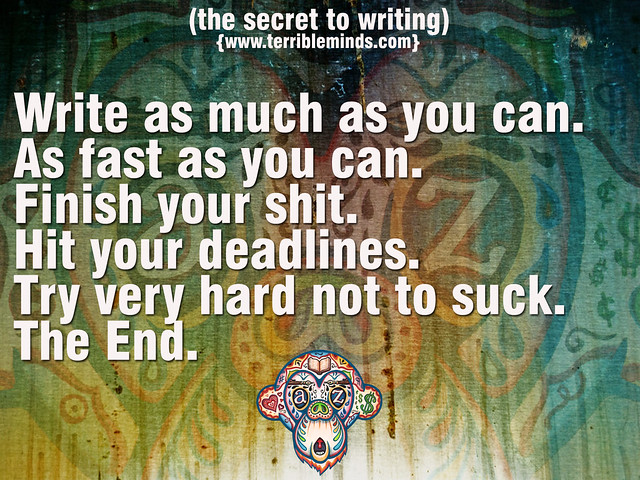
And here’s Chuck’s secret to writing:

source (re-sized here, and he did register it with a Creative Commons license, so share away!)

Dude, where’s your story?

Hi, peeps–

Hope everything finds you groovy. I’m currently working on my latest novels. One is the third installment of my science fiction series and the other is the fourth book in my New Mexico mystery series. And I like to keep up with blogs that offer tips and writing hints/fun stuff for authors. To that end, this post by writing guru Lisa Cron over at Writer Unboxed has some excellent advice.

The post, titled “The Biggest Mistake Writers Make and How to Avoid It,” notes that STORY is the crapfall for writers. That is, many writers don’t know what that is or how it works within the framework of their plot. You’re scoffing. But wait. Hear Lisa out.

So even though they have a great idea and their prose is gorgeous, there’s no story, thus no sense of urgency, and ultimately, no reader. It’s as simple – and heartbreaking – as that. And it’s extremely common.
(from “Biggest Mistake“)

Does that make sense? Really think about that. No story = no sense of urgency. Lisa tells us that THIS is what her definition of a story is:

A story is how what happens (the plot) affects someone (the protagonist) in pursuit of a difficult goal (the story question) and how he or she changes as a result (which is what the story is actually about).
{from “Biggest Mistake”)

A story, she says, is not about the plot. It’s about how the plot affects the protagonist. It’s thus INTERNAL, not external.

Thus, first and foremost, a story is about how the protagonist makes sense of what happens, and how she then reacts as she pursues her goal. In short, it’s not about what she does, it’s about why she does it.
(“Biggest Mistake”)

Cron then notes 5 reasons that can make your story go astray. I’ll give you Point 3, here:

3. Good novels very often trick us into believing that the writer never ventured into the protagonist’s mind, when in fact, that’s where the story unfolded.

Pull just about any novel off your shelf and look specifically for how the writer is conveying the protagonist’s internal reaction to what happens; you’ll see it everywhere. When reading for pleasure it’s nearly invisible, precisely because it’s how the novel gives us the sense that we’re in the protagonist’s skin. That’s why it’s maddening that writers are often warned not to include internal thought. Why is this advice given? Because when done poorly, internal thought can turn into long, rambling, irrelevant monologues that derail a story. So the best advice is simply this: learn to write internal thought well. After all, it’s what lets us know how the protagonist is really responding to what’s happening, and that’s where the power of story lies.
(“Biggest Mistake”)

Author Joan Opyr and I had a conversation about writing and writing styles a while back. She observed that good writing and good structure means that a reader is caught up in the reading. She said it’s when all the moving parts work seamlessly together. When they don’t — when there’s a little hiccup or a grinding of the gears — that means the novelist missed something in the telling of the story.

I struggle with story myself, and I know I’m not the only author out there who does. Cron leaves us with this advice: “. . .in the beginning, it’s all about nailing the story. When you get to that last draft (which will most likely be many drafts away), it’s about polishing the prose.”

Good reminder. Thanks, Lisa.

Happy reading, happy writing!

On health and happiness

Hi, all–

Been busy ’round here. If you haven’t yet, you might want to cruise over to Women and Words, especially on Fridays, because the summer blast tour is going on with several authors. On a whole bunch of Fridays, I’ll be chatting with different authors who write LGBTQ fiction. Most of them are doing book giveaways, as well, so you might score some new reading material. So far, I’ve chatted with Renée Bess, Lynette Mae, and Kate Mclachlan. And there are more to come! So come on by and hang out!

Anyway, I caught this blog by author Tracy Cooper Posey, who writes romance and paranormal/urban fantasy. In it, she offers 11 tips as to why authors should consider building and maintaining good health as those things relate to writing.

Interested about my take on links between health and happiness? Read on…

Continue reading

Sometimes to write, you must stop

Came across this post over at The Write Practice.

Joe Bunting says that sometimes, in order to write (create), you must stop writing. He uses Bob Dylan and Ernest Hemingway as examples of artists who stopped their chosen work, put it aside, and came back better than ever. Bunting says that he does not write once a week. That includes no Tweeting or emailing. He takes a break.

Continue reading

Finding your fiction in nonfiction

Hey, folks–

I read a lot of different stuff, all the time. Part of my regular reading material is nonfiction, not just because it’s interesting but because real life provides a lot of interesting story ideas. Especially since I write genre fiction. So here are a few articles I’ve recently read that maybe you’ll find give you some ideas. Especially if you write genre fiction, too.

The Vanishing,” by Bob Briel, Outside (July 2012)
In the stunning and remote wilderness along northern British Columbia’s Highway 16, at least 18 women — by some estimates, many more — have gone missing over the past four decades. After years of investigation, authorities still don’t know if it’s the work of a serial killer or multiple offenders. BOB FRIEL drives into the darkness for answers.

I’m also a huge fan of travel writing. Try this one (winner of the bronze Solas award, by the editors of Travelers’ Tales):
Letting Go on the Ganges,” by Kristin Zibell
A recently divorced woman finds endings and beginnings in India.

Mexico Feeds Me: Exploring Mexico’s Culinary Heritage,” by Javier Cabral (Saveur, first published in issue #138)
In rural Zacatecas, Mexico, a young writer explores his heritage by cooking the rustic, boldly flavored dishes of the region.

I’m also a westerner born and bred, so I’m a sucker for a western-flavored essay.
West to East, and a world away,” Charles Finn (Writers on the Range, in High Country News, February 17, 2012)
After 20 years in the West (and he’s come to love it), a writer has to go back East.

And maybe something you didn’t think you’d ever WANT to think about: Jailhouse food.
An Insider’s Guide to Jailhouse Cuisine,” by Sean Rowe (Oxford American [the Southern Magazine of Good Writing], originally appeared in Issue 61, The Oxford American Best of the South issue, 2008)
The author spends time in jail, and offers us this slice of life in the big house and the role of food therein.

So there you are, peeps. Maybe you’ll find some…ah…food for thought in some of these pieces and BOOM the next plot for your next novel will hit you.

Happy writing, happy reading!

Can you relate?

I might officially be an anachronism.

I’m still using a flip phone, and I don’t use it to access the web. I actually dial people’s numbers and TALK to them. Oh, sure, I’ll text as well and send a few photos. But I mostly use it to TALK.

I’m Gen X, which means I’m an immigrant to the digital world. I grew up without the interwebs, without voicemail (or answering machines), without cable, without cell phones, and without DVDs. VHS came along in the late 70s/early 80s, but most of us saw movies at the theater when they were released. (Oh, want more info about how primitive and weird things were for my generation? Here.)

I spent most of my summers outdoors with friends, or we got together at each other’s houses. We’d call each other on landlines and if nobody answered, we figured he or she was busy and we’d call back later. Or, if they did have answering machines, we’d leave a message. Eventually, we’d catch up with each other. No big deal if it took a few hours. Or a day or two. We all had other things to do. We’d meet up at various hangouts and get caught up on rumors, gossip, and plans for the upcoming days.

Point being, we TALKED. Face-to-face and on the phone.

That, I think, is becoming a lost art.

Want more? Keep reading…

Continue reading

Time warps and writing

Hiya, peeps–

If you haven’t strolled down 80s lane with me and you’d like to, pop on over to Women and Words. Because I totally went on a nostalgia tour.

One of the comments over there mentioned Armistad Maupin’s work, and yes, I’ll concur. His first Tales of the City captured a particular era and community at a critical juncture in its history. I mentioned several movies that might have some of you walking down your own nostalgic road. Unless you were born AFTER the era, in which case, it’s a great historical lesson, especially if you want to set any of your writings in the 80s. 😀

And that led me to THIS thought. No interwebs, no smart phones (and very few mobile phones), not much by way of cable TV, VHS, and satellite TV dishes nearly the size of the ones at the VLA. OMG how DID we survive? Easily. Because that’s how things were. Those of us who came of age in that era are thus immigrants to the digital world, as opposed to the younger generations who were born into it/with it. Those folks don’t know what it is to NOT have the interwebs and mobile/smart phones. So think about how technology and what’s available figures into plots and characters.

Here’s what I mean by that.

So that’s how a jog down memory lane made me think about writing.

Happy weekend!

Writing news n’ stuff

Hi, folks–

Some cool stuff I ran across. For those who are not in the know, there’s a new professional organization out there for indie authors. The Alliance of Independent Authors can be checked out HERE.

Jane Friedman, guru of many things publishing, is one of the advisors, as is Mark Coker of Smashwords, Joanna Penn of Creative Penn, and Victoria Strauss of Science Fiction Writers of America.

Jane offers a video discussion about publishing, self-publishing, marketing, and groovy things like that at this link.

I’m a fan of professional organizations, because they offer networking venues, workshops, advice, and other benefits (some writers’ organizations can offer health insurance). So if you’re an indie author who’s looking to benefit professionally, the Alliance of Independent Authors might be for you.

Having trouble keeping with the writing? There’s an app for that. Write or Die is designed to encourage you to keep writing. Download the app and start typing in the box provided. There are 3 settings. The gentle mode provides a kind reminder to keep writing if you’ve stopped and haven’t written after a few seconds. It’s a pop-up box. The second, or “normal” mode, emits an icky sound if you’ve stopped writing that doesn’t stop until you start tapping away again. And the “kamikaze” mode starts erasing what you’ve typed after a few seconds. Whichever mode you choose, the app will dole out “prods” until you’ve met your word count and/or time goal.

Whew. Scary. Anyhoo, I’ve also posted a teaser from book 3 in my space opera series, the Far Seek Chronicles. You can check that out RIGHT HERE.

All rightie. Hope everybody’s having a great week!

Happy writing, happy reading!

More processing

I was reading the latest issue of Writer’s Digest (I highly recommend you try a subscription to this mag — it usually contains good writing and promo tips for authors plus interviews with authors) and came across an interview with Andre Dubus III, who wrote The House of Sand and Fog (among many others). The film based on that book was an Oscar nominee. The book itself was a finalist for the National Book Award.

Dubus is a larger-than-life kinda guy. Boston brawler born, who looks like the literary love child of John Mellencamp and Kurt Russell (that’s Zachary Petit’s description and I agree), he’s comfortable sharing a laugh and a pint as well as writing these intensely dark and poignant stories that leave us wrung out, alone, and wondering where the good is in being human. He taps the deep and lives his truth, which may be why his writing resonates with so many.

How does he do it? I like to find out about other writers’ processes. That is, the actual mechanical things they do to prepare for a writing session. Here’s Dubus’ process, from the article in Writer’s Digest:

“Andre Dubus III is both artist and businessman. It’s methodical: Every morning, Dubus wakes up and takes his kids to school (he lives in Massachusetts with his wife, who is a professional dancer, and two of his three children). He returns home. It’s empty of everyone except the dog. He takes a cup of black dark roast coffee down to the basement, where he’s built a 5-by-11 sound-proofed room. He sits at a desk in front of a blank wall, types the previous day’s longhand writing into the computer, then turns the machine off. He sharpens a pencil with a knife, reads three or four poems — for ‘the high bar of language that poets always give us prose writers’ — and then stares at the page.

‘I try to put myself in a state of openness and receptivity and not try to say anything and not think it, but dream it. And then I pick up where I left off.’

He writes for two to three hours, goes to the gym to clear his head (he still works out ‘like a demon’), and that’s it.

When it comes to creating a piece of writing, Dubus believes the story has to percolate in our mind — and that you shouldn’t write it too early.

‘There’s a profound difference between making something up and imagining it,’ he says. ‘Imagining it instead is falling into your psyche, your imagination, and finding some aspiring writer asks him a career question, he says he gets uncomfortable — he’s happy to help, but wants to know if the person has done the real work first: painstakingly crafted the words.”
From “Meet the Real Andre Dubus III,” by Zachary Petit (Writer’s Digest, July/August 2012), p. 43.

The interview itself is not available on the Writer’s Digest site unless you’re a subscriber (it’s in the print version, though), but you can get some of Dubus’ other words of wisdom from the site HERE.

So, writers. What’s your process? Does it seem to work? Would you change it if you thought it would open new windows for you? Just curious.

Happy Sunday.